|
Published by Contemporary Research Center CRC Publications |
 |
|
|
|
Validation of the Rosenberg Self-Esteem Scale - Rses (Rosenberg, 1965)Danijela Jelisavac Abstract The purpose of the research is to check the reliability, validity and factor structure of Rosenberg's self-esteem scale - RSES (Rosenberg, 1965). We checked reliability with the values of Cronbach α coefficients, factor structure with factor analysis and convergent validity with the Self-Esteem Scale (Lamovec, 1987), divergent validity with the GAD-7 anxiety scale (Spitzer et al., 2006) and criterion validity with the satisfaction with life scale - SWLS (Diener, Emmons, Randy, & Griffin, 1985). On a sample of 206 Slovenian elementary school teachers, we confirmed both the reliability and the validity and the factor structure of the RSES scale, but we drew attention to some shortcomings. The results of our research can contribute to the further study of the RSES scale as well as its use with the aim of spreading positive psychology in schools and in everyday life, since the self-esteem of teachers is crucial for establishing authority in the school. Keywords: self-esteem, RSES scale, reliability, validity. 1. THEORETICAL INTRODUCTION 1.1 Self-esteem Self-esteem is an integral part of self-concept, which includes a critical judgment about one's own worth. It is a combination of how others perceive us and how we perceive their perceptions. It plays an important role in the psychological well-being of the individual (Payne and Walker, 2002) and is an important factor in the development and maintenance of good psychological health (Macinnes, 2006). A high level of self-esteem is related to the satisfaction of psychological needs or a good general psychological well-being (Lakey, Hirsch, Nelson and Nsamenang, 2014) and depends on the match between the actual and ideal self (Escolar Chua and de Guzman, 2014). Self-esteem depends on whether an individual can achieve his important goals. A decrease in self-esteem can cause problems (e.g. depression, anxiety, indifference and feelings of loneliness) (Filej and Žvanut, 2016). As with most psychological constructs, self-esteem has several definitions. Although there are several definitions, they all have in common the fact that self-esteem roughly involves a broad, deep and complete experience of oneself, which includes thoughts, feelings, perception, subjective evaluation of oneself, which can develop in a positive or negative direction or accepting or rejecting oneself. (Colnerič, 2017). Nosek (2016; in Colnerič, 2017) adds to the classic definitions that "self-esteem can be defined as an individual's competence to perceive himself as a worthy person over a long period of time when facing challenges". With a similar problem or a dilemma most self-esteem researchers have been dealing with in the last decade. Namely, they ask whether self-esteem is a stable construct over time, or whether it changes depending on the situation and circumstances. It is known that it begins to develop already in childhood and begins to increase more markedly during the period of late adolescence and early adulthood. It reaches its peak between the ages of 50 and 60 and begins to decline with age (Lucciano and Orth, 2017; in Colnerič, 2017). It is necessary to distinguish between the concepts of self-esteem and self-esteem, which people often equate, but in psychological circles they are treated as two separate psychological constructs. In English, the phrases self-concept and self-image are used for self-concept, and self-esteem and selfworth are used for self-respect (Colnerič, 2017). The APA (b. d.a) defines self-esteem as "the degree to which the qualities and characteristics contained in an individual's self-image are perceived as positive." The latter includes an individual's physical self-image, view of achievements and abilities, and values and ways about what image other people create about you. It goes without saying that the more positive experience is expressed in relation to the aspects mentioned, the higher the level of self-esteem. A high level of self-esteem influences optimal mental health, while a low level of selfesteem causes feelings of worthlessness and is a common indicator of depressive symptoms (ibid.). The concept of self-worth is defined by APA (b. d.b) as "an individual's evaluation of himself as a worthy, capable human being who deserves respect and consideration." Some researchers and authors perceive the described concepts as the same, others consider them to be different. It should differ in that self-esteem refers to an individual's thinking and feeling about himself, which changes depending on circumstances, feelings, confirmations from others, while selfworth is a more global and stable construct based on individual beliefs and values (Shafir, 2021). 1.2 Similar constructs: self-image, self-respect, self-awareness and identity In the following, four psychological constructs are briefly described, which are related to the considered construct of self-esteem. These are self-image, self-respect, self-awareness and identity. Kompare (2006) defines self-image as a set of ideas we have about ourselves, as it is an individual's experience of himself. Kuper and Kuper (1976, in Arip, Saad, Rahman, Salim, & Bistaman, 2013) add that self-image is how we see ourselves from another perspective. Self-image is not an independent, rigid entity, but a dynamic structure that consists of several dimensions; these can change (Arip, Saad, Rahman, Salim, & Bistman, 2013). Self-respect has a significant impact on an individual's self-esteem and self-confidence (Price, 2010). Horvat (2011) believes that self-confidence means awareness of oneself, one's feelings, well-being and reactions in certain situations. Selfconfidence gives an individual the confidence to master certain areas (e.g. that he is good at solving mathematical problems; that he knows himself so well, etc.) Self-awareness is the ability to make a person the object of one's own attention (Duwal and Wicklund, 1972). A person actively recognizes, processes and stores information about himself (Morin, 2011). Within the objective self-awareness theory of Duval and Wicklund (1972), selfawareness is defined as a critical factor that determines whether an individual's behavior is influenced by the situation in which he finds himself or by the individual's thought processes. The authors believe that an individual is more influenced by his personal characteristics, standards and behaviors when he thinks about himself, but when he is not thinking about himself, he is more spontaneous and influenced by the current situation in which he finds himself (Leary, 2004). The central aspect of identity is self-awareness in the direction of the fusion of the individual characteristics of the individual and the characteristics of society. Identity thus becomes a bridge or mediator in the relationship between an individual and society (Zago, 2022). An individual's identity is not a stable structure of his personality but is constantly reshaped and transformed. Through the processes of identity formation (determining the difference between oneself and others) and identification (recognizing similarities with others who are part of the same social entity), the individual changes and consolidates the ways in which he presents himself and how he presents himself to others in social interactions (Daher, 2013; Gallino, 1983). 1.3 Measuring self-esteem Self-esteem is often measured with the Rosenberg self-esteem scale (RSES; Rosenberg, 1965). The ten-item scale measures the level of general self-esteem, or the general attitudes that an individual takes towards himself. Participants rate items on a Likert-type rating scale from 1 to 4. Higher scores indicate higher self-esteem. Five items are reverse valued (3, 5, 8, 9 and 10) (Marčič and Kobal Grum, 2009). The Self-Esteem Scale (Lestvica samospoštovanja - LS, Lamovec, 1987, in Lamovec, 1994) is also often used to measure self-esteem. In addition to self-confidence, the scale also measures the social, emotional and physical self. It is a shortened version of the LS, the LS2 questionnaire - self-esteem scale 2, which contains 19 items. In the questionnaire, the author (1990: 84-86) selected items that appear most often in relation to self-esteem: social, emotional and physical self (Peterlin, 2009). When testing the questionnaire, Prodan (1990; in Lamovec, 1994) found that when the number of items is reduced, the three factors mentioned are combined into a single factor of general self-esteem. The purpose of the research is crucial for the selection of a longer or shorter version of the questionnaire. The shorter version has a slightly modified scoring method and is easier to evaluate. Points are added together, with a high score indicating high self-esteem (which is more common). About half of the items are designed to reflect high self-esteem and the other half low (Avsec, 2007). The Self-Esteem as a State (SSES) questionnaire is also used to measure self-esteem (Heatherton and Polivy, 1991; in Lamovec, 1994). It was adapted into Slovenian by Lamovec (1994). The questionnaire contains 20 items to which the participant answers on a five-point scale according to the extent to which the item is true or not true for him at that moment (1 - not true at all, 2 - slightly true, 3 - moderately true, 4 - very true, 5 - completely true). 13 items are reverse scored (2, 4, 5, 7, 8, 10, 13, 15, 16, 17, 18, 19 and 20) (Komat, 2014). With the help of factor analysis, three factors were identified: efficiency, social respect and appearance. The factors mentioned explain 50.4% of the variance and have proven to be very stable (Lamovec, 1994). 1.3 Relationship between self-esteem and our studied constructs Self-esteem is widely studied abroad, as the RSES scale is very well known. In Slovenia, we also have some measuring tools for measuring self-esteem, so we decided to investigate the selected construct also in the Slovenian area and with a Slovenian questionnaire, and thus check the convergent validity of the RSES scale. To examine divergent validity, we chose the construct of anxiety, which has often been studied in relation to self-esteem. The relationship between self-esteem and anxiety was investigated using questionnaires administered to 5,077 high school juniors and seniors in a stratified random sample of ten high schools in New York State. It is interesting to note that the symptoms most associated with self-esteem are also those most clinically associated with anxiety. (Rosenberg, 1962). To check the criterion validity, we chose the construct of satisfaction with life, since this construct has also been studied in relation to some personality traits. The specific connection between selfesteem and life satisfaction was also studied. Results on the SWLS scale correlate moderately to highly with other subjective measures of well-being and predictably correlate with specific personality traits such as, for example, the RSES scale (Diener, Emmons, Larsen, & Griffin, 1985). 2. METHODOLOGY 2.1 Problem, purpose and objectives Objective: To check the reliability, validity and factor structure of Rosenberg's self-esteem scale - RSES (Rosenberg, 1965) P1: Check the factor structure of the instrument. P2: Check the reliability of the instrument. P3: Check the (a) convergent, (b) divergent, and (c) criterion validity of the instrument. H1: In accordance with the factor structure of the original Rosenberg self-esteem scale - RSES (Rosenberg, 1965), we expect a one-factor structure of the Slovenian version of the RSES. H2: A satisfactory level of reliability of the entire validated scale is expected (α >.70). H3a: A satisfactory degree of convergent validity of the entire scale is expected, with correlations of the total score on the Rosenberg Self-Esteem Scale with the total score of the self-esteem subscale of the Self-Esteem Scale (Lamovec, 1987) >. 60. H3b: A satisfactory level of divergent validity of the entire scale is expected, with correlations of the total score on the Rosenberg Self-Esteem Scale with the total score on the Generalized Anxiety Scale (GAD-7; Spitzer et al., 2006) < . 30. H3c: Rosenberg's self-esteem scale is expected to statistically significantly predict the level of satisfaction with life (research Pluzarić, Ivakovac, Železnikl, 2016). 2.2 Sample The participants are teachers in Slovenian primary schools. The sample was collected using the snowball method via the Facebook social network. The expected number of participants was around 200. We expected that at least 20% of the sample would be male.
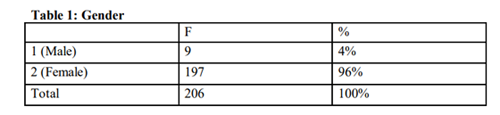
As can be seen from the table above, the research is strongly dominated by female participants. They represent 96% of all participants, while men make up the remaining 4%. The latter is considerably below the expectations we had before the research. Due to the inequality of the sample by gender, in the case of the research in question, it is pointless to make comparisons based on this demographic data.
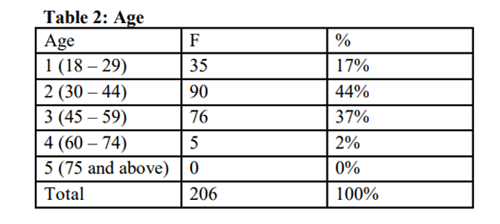
The table above shows that the largest number of participants are represented in the age categories of 30-44 years (44%) and 45-59 years (37%). This is followed by participants in the age category 18-29 years (17%) and 60-74 years, while there are no older people. The distribution according to age category offers the possibility of appropriate analyzes and comparisons, especially according to the first three age categories.
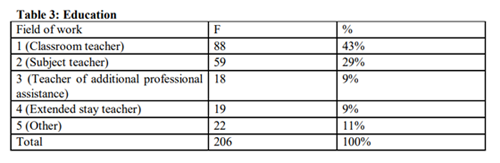
According to education or type of work, the participants are divided in such a way that the largest share is represented by classroom teachers (43%), followed by subject teachers (29%), while teachers of additional professional assistance and teachers of extended stay each comprise a 9% share of all participants. 11% of participants chose the second option.
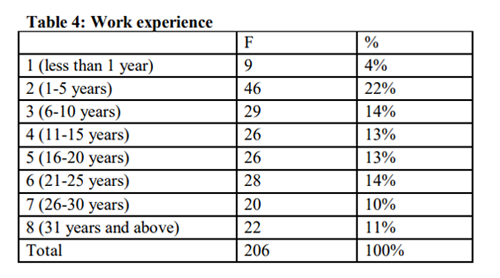
As can be seen from the table above, the participants are very evenly distributed according to work experience. Most participants have 1-5 years of work experience (22%), while the smallest share is represented by participants with less than one year of work experience (4%). The representation of other ranges of work experience ranges from 10-14%. 2.3 Instruments Self-esteem will be measured with the Rosenberg self-esteem scale (RSES; Rosenberg, 1965). The ten-item scale measures the level of general self-esteem, or general attitudes that an individual takes towards himself. Participants rate items on a Likert-type rating scale from 1 to 4. Higher scores indicate higher self-esteem. Five items are reverse valued (3, 5, 8, 9 and 10) (Marčič and Kobal Grum, 2009). To test the convergent validity of Rosenberg's self-esteem scale, we will use the Self-Esteem Scale (LS, Lamovec, 1987, in Lamovec, 1994). In addition to self-confidence, the scale also measures the social, emotional and physical self. It is a shortened version of the LS, the LS2 questionnaire - selfesteem scale 2, which contains 19 items. In the questionnaire, the author (1990: 84-86) selected items that appear most often in relation to self-esteem: social, emotional and physical self (Peterlin, 2009). When testing the questionnaire, Prodan (1990; in Lamovec, 1994) found that when the number of items is reduced, the three factors listed are combined into a single factor of general self-esteem. The purpose of the research is crucial for the selection of a longer or shorter version of the questionnaire. The shorter version has a slightly modified scoring method and is easier to evaluate. Points are added together, with a high score indicating high self-esteem (which is more common). About half of the items are designed to reflect high self-esteem and the other half low (Avsec, 2007). To determine divergent validity, we will use the GAD-7 Generalized Anxiety Scale (Spitzer et al., 2006), which includes seven statements and serves as a short clinical self-assessment. Participants rate on a four-point scale (0 - never, 3 - almost every day) how often in the last 14 days they experienced the symptoms listed in the scale. It is usually used as a screening tool to identify elevated anxiety as a disorder. The scale is freely available online. Both the PHQ-9, used as a screening questionnaire for depression, and the GAD-7, used as a screening questionnaire for anxiety, are freely available, short, reliable, and valid. They contain optimal criteria for the detection of psychological symptoms. They are available in many European languages (Depression, Anxiety and Cystic Fibrosis: Guidelines for Professionals, n.d.) The Satisfaction with Life Scale (Diener, Emmons, Randy, & Griffin, 1985) is a brief five-item instrument. It measures global cognitive judgments of an individual's satisfaction with their own life. It measures the assessment that relates to the fulfillment of the individual's life goals, the perception of the individual's living conditions and the achievement of matters important to the individual. The scale is evaluated on a five-point Likert scale (1 - do not agree at all, 2 - do not agree, 3 - partially disagree, 4 - agree to 5 - partially agree). The sum of the points in the questionnaire shows the individual's satisfaction with his life (31 - 35 points = very satisfied, 26 - 30 = satisfied, 21 - 25 = partially satisfied, 20 = neutral, 15 - 19 = partially dissatisfied, 10 - 14 = dissatisfied, 5 - 9 = very dissatisfied) (Diener et al., 1985). The questionnaire has been used several times in Slovenia, the coefficient of internal reliability is 0.79 in the research by Poljšak Škraban (2010), and 0.87 in the research by Plemelj Mohorič (2016). 2.4 Data collection and processing We shared the questionnaire via social networks and addressed acquaintances. This resulted in a random sample. Data were collected in March/April 2023. 206 adults – 9 men and 197 women – were included in the survey and represent the sample in further analysis. The data were statistically processed using the JASP tool. To check the construct validity of the RSES questionnaire, we performed a factor analysis; to check the reliability of the questionnaire, we calculated the values of Cronbach α coefficients; to check the convergent and divergent validity, we checked the correlation coefficients between the scales, and to check the criterion validity, we performed a regression analysis. The survey was conducted online. A link to a questionnaire that participants could answer was published on the social network under the name "Do I value myself enough?" to attract as many participants as possible. By clicking on the link, the participants anonymously provided their answers to the scales described above. Participants first completed a questionnaire on sociodemographic data, and then completed 4 scales. The estimated completion time was 10 minutes. Respondents were informed of the anonymity of participating in the research. Before starting to solve the online questionnaire, the participants read an instruction in which the aim and purpose of the research were explained, and it was emphasized that the research was anonymous and voluntary. It was also emphasized that participants can withdraw from participation at any time without consequences, that the data obtained will be used exclusively for research purposes and that they will be analyzed at the group level. It was explained that by clicking on the next page, the participants consent to the research. The research was conducted online, where the participants did not enter their name, e-mail or other personal information, which ensured their anonymity. 3. RESULTS 3.1 Checking the construct validity of the RSES questionnaire First, we performed a confirmatory factor analysis within the framework of construct validity. When checking the conditions and suitability indices, we found that two of them do not comply with the prescribed limit values, namely TLI (0.885) and RMSEA (0.102). As a result, the factor loadings of some items also had a value smaller than 0.40. Due to the inadequacies, we performed an exploratory factor analysis. Parallel analysis indicated that a one-factor structure should be maintained, but further analysis indicated the possible existence of two factors. Assuming a two-factor structure, the fit indices are greatly improved, only the TLI remains slightly below the threshold value. Items 1, 2, 5, 6, 8, 9 and 10 should be associated with the first factor, and items 3, 4 and 7 with the second. After examining the content of the presumed two-factor structure, the items of the second factor mostly relate to the assessment of self-esteem, which is the result of comparison with other people, which is not observed in the items of the first factor. Hypothesis H1 (According to the factor structure of the original Rosenberg self-esteem scale - RSES (Rosenberg, 1965), we expect a one-factor structure of the Slovenian version of the RSES), we can therefore confirm despite the indication of the existence of two factors, as the authors of foreign studies did. McKay, Boduszek, and Harvey's (2014) research results supported a bifactor model when examining the factor structure of the RSES questionnaire, including item loadings, fit indices, reliability scores, and correlations with self-efficacy measures, suggesting that the two hypothesized factors are better understood as factors "groupings" rather than as representative of latent constructs. Accordingly, the study supports the one-dimensionality of the RSES scale and the scoring of all 10 items to create a global self-esteem score. 3.2 Checking the reliability of the instruments used Reliability was checked on all used scales and subscales, with the following results:
the reliability of the RSES scale is high (Cronbach α = 0.877), Hypothesis H2 (A satisfactory level of reliability of the entire validated scale is expected (α >.70)) can thus be confirmed. The results are consistent with the reliability scores of the original scale, where the RSES showed high scores in the areas of reliability; internal consistency was .77 (Rosenberg, 1965). 3.3 Checking the convergent validity of the RSES questionnaire The convergent validity of the RSES scale was checked with the LS scale. The results showed statistically significant correlations between the scales (p < 0.01) and a positive, strong correlation (r = 0.817). The RSES correlates to the highest extent with the self-esteem subscale (r = 0.742), followed by the emotional self-subscale (r = 0.726) and the social self-subscale (r = 0.689), and to the smallest extent with the physical self-subscale (r = 0.633). which is probably due to the low reliability of the subscale because of too few items. Hypothesis H3a (A satisfactory degree of convergent validity of the entire scale is expected, with correlations of the total score on the Rosenberg Self-Esteem Scale with the total score of the selfesteem subscale of the Self-Esteem Scale (Lamovec, 1987) >. 60) can thus be confirmed, as the correlation coefficient between the Self-Esteem Scale and RSES high enough, but it would be interesting to pay a little more attention to the correlation of the RSES scale with the individual subscales of the Self-Esteem Scale. 3.4 Checking the divergent validity of the RSES questionnaire The divergent validity of the RSES scale was checked with the GAD-7 scale. The results showed statistically significant correlations between the scales (p < 0.01) and a negative, moderately strong correlation (r = -0.579). In other words, the higher an individual's level of self-esteem, the lower his level of anxiety. This confirmed the divergent validity of the scale. Hypothesis H3b (A satisfactory level of divergent validity of the entire scale is expected, with correlations of the total score on the Rosenberg Self-Esteem Scale with the total score on the Generalized Anxiety Scale (GAD-7; Spitzer et al., 2006) r < 0.30) can thus only partially be confirmed, since the level of divergent validity is otherwise satisfactory, but the value of the correlation coefficients was not lower than 0.30 (r =-0.579). Sinclair et al. (2010) reported that the RSES correlated (r = -0.62) with the 7-item Depression and Anxiety Scale (Lovibond and Lovibond, 1995). Rosenberg (1962) found a clear negative correlation between self-esteem and anxiety, which also coincides with the results of our research. 3.5 Checking the criterion validity of the RSES questionnaire We checked the criterion validity of the RSES scale using regression analysis, where we assumed that self-esteem predicts satisfaction with life. We used the Satisfaction with Life Scale (SWLS). In the first step of the regression, we found that no sociodemographic factor has a statistically significant effect in our model. It is possible that the reason for this is a characteristic of the sample, as it is dominated by the female gender, and we did not reach the planned 20% share of male representation. In the second step, we found that self-esteem statistically significantly predicts satisfaction with life (p < 0.01; β = 0.614), which confirmed the criterion validity of the scale. Hypothesis H3c (The Rosenberg self-esteem scale is expected to statistically significantly predict the level of satisfaction with life (research Pluzarić, Ivakovac, Železnikl, 2016)) can thus be confirmed. Diener, Emmons, Larsen, and Griffin (1985) found a positive correlation between the SWLS scale and the RSES (r = 0.54), which also coincides with the findings of our research. 4. DISCUSSION AND CONCLUSION The purpose of this work was to check the factor structure, reliability and validity of Rosenberg's self-esteem scale - RSES (Rosenberg, 1965) in the Slovenian language, for psychologists from the field of positive psychology to reduce the psychological damage caused by increasing social pressures on the teaching profession. Convergent validity was checked with the Self-Esteem Scale, divergent validity with the GAD-7 anxiety scale, and criterion validity with the SWLS life satisfaction scale. The results of our research support the factor structure, reliability and validity (both convergent and divergent and criterion) of the RSES scale in accordance with foreign research (McKay, Boduszek and Harvey, 2014; Rosenberg, 1965; Sinclair et al., 2010; Diener, Emmons, Larsen and Griffin, 1985). We see the shortcoming of the research in the insufficient sample size (206) and the insufficient representation of the male gender (9). For further research, it would be necessary to increase the sample and obtain enough respondents of both sexes. It would be interesting to perform analyzes also with the two-factor structure of the RSES scale, as proposed by some authors, and to undertake a more detailed study of the relationship between the RSES scale and the subscales of the Self-Esteem Scale. The risks of this research were minimal, if someone felt anxious and uncomfortable about completing the questionnaire, they could stop participating in the research at any time. We believe that in addition to contributing to the further study of the scale, the scale can contribute to the promotion of positive psychology in Slovenia, both in the field of theory and in the field of practice in schools, as teachers' self-esteem is essential for successful work in the classroom and establishing authority. REFERENCES 1. American Psychological Association (n. d.). Self-esteem. APA Dictionary of Psychology. https://dictionary.apa.org/self-esteem 2. American Psychological Association (n. d.). Self-worth. Apa Dictionary of Psychology. https://dictionary.apa.org/self-worth 3. Arip, MASM., Saad, F. M., Rahman, AMA., Salim, SSSS. & Bistaman, M. N. (2013). Translation, validity and reliability of Multidimensional Self-Concept Scale (MSCS) questionnaire among Malaysian teenagers. Procedia – Social and Behavioral Sciences, 84, p. 1455–1463. doi:10.1016/j.sbspro.2013.06.773. 4. Avsec, A. (ed.) (2007). Psihodiagnostika osebnosti. Ljubljana: Univerza v Ljubljani, Filozofska Fakulteta, Oddelek za psihologijo. 5. Colnerič, N. (2017). Samospoštovanje, strah pred intimo in neomejenost socioseksualnega vedenja [Master thesis]. Univerza v Ljubljani, Teološka Fakulteta. https://repozitorij.unilj.si/Dokument.php?id=108696 6. Daher L. (2013) ‘Che cosa è l’identità collettiva? Denotazioni empiriche e/o ipotesi di ipostatizzazione del concetto’, Società Mutamento Politica, 4, 8, 125–139. 7. Diener, E., Emmons, R. A., Larsen, R. J. & Griffin, S. (1985). The Satisfaction With Life Scale. Journal of Personality Assessment, 49(1), 71–75. doi:10.1207/s15327752jpa4901_13. 8. Duval, S. & Wicklund, R. A. (1972). A theory of objective self-awareness. New York: Academic Press. 9. Escolar Chua, R. L. and de Guzman, A. B. (2014). Effects of third age learning programs on the life satisfaction, self-esteem, and depression level among a select group of community dwelling Filipino elderly. Educational Gerontology, 40, p. 77–90. doi: 10.1080/03601277.2012.701157. 10. Filej, B. & Žvanut, B. (2016). Vpliv spola in starosti na samopodobo in samospoštovanje starejših. Revija za zdravstvene vede, 1, p. 29-42. https://www.jhs.si/index.php/JHS/article/view/35/35. 11. Gallino L. (1983) ‘Identità, identificazione, relazioni seriali e alternanze’. In Balbo L. (ed.) Complessità sociale e identità. Milano, Franco Angeli. 12. Horvat, A. (2011). Samospoštovanje in samozavest. http://www.aktivni.si/natisni/samospostovanje-in-samozavest/. 13. Komat, L. (2014). Samospoštovanje pri paraolimpijcih [Thesis, Univerza v Ljubljani, Pedagoška fakulteta]. http://pefprints.pef.unilj.si/2606/ 14. Kompare, A. (2006). Uvod v psihologijo. Ljubljana: DZS. http://tusmo.si/clanki/samopomoc/tvoja-samopodoba/. 15. Lakey, C. E., Hirsch, J. K., Nelson, L. A. and Nsamenang, S. A. (2014). Effects of contingent self-esteem on depressive symptoms and suicidal behavior. Death Studies, 38, p. 563–570. doi: 10.1080/07481187.2013.809035. 16. Lamovec, T. (ed.) (1994). Psihodiagnostika osebnosti 2 [Psychodiagnostics of personality 2]. Ljubljana: Univerza v Ljubljani, Filozofska fakulteta, Oddelek za psihologijo in Znanstveni inštitut Filozofske fakultete. 17. Leary, M.R. (2004). The curse of the self. Self-awareness, egotism and the quality of human life. New York: Oxford University Press. 18.Lovibond, P. F., & Lovibond, S. H. (1995). The structure of negative emotional states: comparison of the Depression Anxiety Stress Scales (DASS) with the Beck Depression and Anxiety Inventories. Behaviour research and therapy, 33(3), 335–343. https://doi.org/10.1016/0005-7967(94)00075-u. 19. Macinnes, D. (2006). Self-esteem and self-acceptance: An examination into relationship and their effect on psychological health. Journal of Psychiatric and Mental Health Nursing, 13, p. 483–489. 20. Marčič, R. in Kobal Grum, D. (2009). Povezanost samopodobe in samospoštovanja z agresivnostjo. Psihološka obzorja, 18(4), p. 59-71. http://psiholoskaobzorja.si/arhiv_clanki/2009_4/marcic_kobal-grum.pdf. 21. McKay, M. T., Boduszek, D., & Harvey, S. A. (2014). The Rosenberg Self-Esteem Scale: a bifactor answer to a two-factor question?. Journal of personality assessment, 96(6), 654–660. https://doi.org/10.1080/00223891.2014.923436. 22. Morin, A. (2011). Self-awareness part 1: Definition, measures, effects, functions, and antecedents. Social and Personality Psychology Compass, 5(10), 807-823, doi: 10.1111/j.1751- 9004.2011.00387.x 23. Payne, S. and Walker, J. (2002). Psihologija v zdravstveni negi. Ljubljana: Educy 24. Peterlin, N. (2009). Povezanost samopodobe s stresom in izgorelostjo zaposlenih v socialnem delu [Thesis, Univerza v Ljubljani, Fakulteta za socialno delo]. https://egradiva.fsd.unilj.si/search/extshow/389. 25. Price, B. (2010). The older womanʼs body image. Nursing Older People, 22, št. 1, p. 33–36 26. Rosenberg, M. (1965). Society and the adolescent self-image. Princeton, NJ: Princeton University Press. 27. Rosenberg, M. (1962). The association between self-esteem and anxiety. Journal of Psychiatric Research, 1(2), 135–152. doi:10.1016/0022-3956(62)90004-3. 28. Sinclair, S. J., Blais, M. A., Gansler, D. A., Sandberg, E., Bistis, K., & LoCicero, A. (2010). Psychometric properties of the Rosenberg Self-Esteem Scale: overall and across demographic groups living within the United States. Evaluation & the health professions, 33(1), 56–80. https://doi.org/10.1177/0163278709356187. 29. Shafir, H. (2021). Self-Worth vs. Self-Esteem: Understanding the Differences. Choosing Therapy. https://www.choosingtherapy.com/self-worth-vs-self-esteem/ 30. Zago, M. (2022). Prostor, šola in identiteta: sinteza multivariatne analize. In: Večjezičnost in identitete v obmejnem prostoru: primer šole s slovenskim učnim jezikom v Romjanu, 87-107. https://www.openstarts.units.it/bitstream/10077/34354/1/15-ZAGO.pdf
|
ISSN: 2411-5681 Online & Print Journal Information
Frequency: Monthly
News Attention to Authors The latest issue |
|
Copyright © 2013-2026 IJER - International Journal of Education and Research. All Rights Reserved • Privacy Policy |