|
Published by Contemporary Research Center CRC Publications |
 |
|
|
|
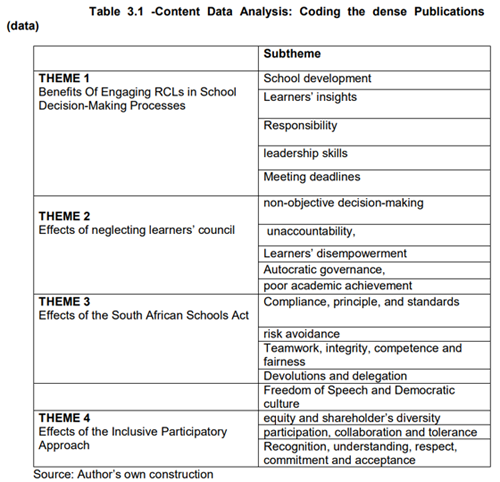
The Role of Representative Council of Learners in Decision Making Processes in The South African Secondary SchoolsSabelo Velenkosini Msweli ABSTRACT The research sought to describe and explore the role of representative student council in South African secondary schools. The research is significant because it aims to legitimise student’s input as active decision-makers. A qualitative descriptive and explorative research methodology was used. Taking responsibility, school growth, learner insights, leadership skills development, and dedication to achieving deadlines are the most relevant advantages of engaging students in decision-making. Also, ignoring student voices leads to non-objective decision-making, unaccountability, the disempowerment of students, and authoritarian leadership in schools. Moreover, the South African Schools Act promotes compliance, avoidance of risk governance, collaboration, justice, and competency in decision-making by enforcing learners' participation. The inclusive, participative method that involves students’ body also fosters cooperation, acceptance of variety, and decisionmaking tolerance. Thus, including student voices in decision-making may improve school decisions. The research found that excluding Learner Representative Council from decision-making processes is unjust treatment done by certain schools for unknown reasons. The study recommended that learners be seen and observed outside of the classroom environment. The study did add to the school's understanding of what leadership styles may be utilised to enhance secondary school performance. Keywords: Decision making, Representative Council of Learners, South African School Act. 1. INTRODUCTION In African culture, children are trained and expected to act in particular ways. Learners must be humble and obedient. Research that deals with student or learners’ contribution to decision-makers in high schools is in great demand today. Occasionally, significant concerns arise about the role of students in the decision making of a school. There are several inconsistencies, outdated, hostile, and conventional behaviour that adversely affect schools. Radebe (2019), noted the need to correct a stigmatised notion that restricts learners to schooling and not as decision-makers. The current research is based on the four most significant angles. First, the research describes and explore the advantages of engaging students in school decision-making. Second, the drawbacks of excluding students from decision making are described and explored. Third, the research describes and then explores the role of the South African Schools Act in promoting fairness and adherence to rules that empower students. Finally, the study described and explored the relevance of inclusive, participatory decision making. 2. BACKGROUND OF THE STUDY Most South African secondary school pupils are merely classified as classroom members. As a result, they must study, learn, and assessed. Although the South African Constitution guarantees pupils the right to free expression, education officials often ignore this right. In 1996, the South African Schools Act was gazetted, requiring all public high schools to form a student body known as a Learner’s Council or Representative Council of Learners (RCLs) (Republic of South Africa, 1996). Some schools still lack a Learner’s Council, which is a significant issue as many public secondary school students are left out of decision-making processes. Even at the researcher's school, some pupils are ignorant of RCLs and its role in education. Every year, students campaign door-to-door with their manifestos to be nominated and elected into the Learner's Council. Thus, the role of students in schools is controversial. With a student council in schools, all students are envisaged to have equal access to decision-making through representation by students’ body. According to Lazarus & Davidoff (2003), the RCLs should prioritise making decisions as schools exist for students. Thus, learners' councils play an important part in decisionmaking processes, provided schools commit to equipping them with fundamental skills, knowledge, and capacities to represent their peers and make meaningful decisions. According to Boddington, King and McWhirter (2014), many schools use the learners' council to reflect on and improve certain administrative areas and weaknesses. However, the student body not recognised by many schools in South Africa (Radebe, 2019). This calls for all key stakeholders to work hard to guarantee that RCLs responsibilities are clarified and recognised by errant schools. In addition, there is still need to worry about student’s exclusion during decision making as in other schools, students play a passive role by not actively express their views during decision-making proceedings. Given the lack of Learner Councils in schools, schools must revisit the South African School Act of 1996 and reflect on what went wrong with its implementation (Republic of South Africa, 1996). The researcher is concerned about the Representative Council of Learners’ lack of active involvement in decision-making. Most South African state-owned secondary schools lack this sub-structure, and those who participate do so passively such that they are not allowed to express themselves on their ideas (Radebe, 2019). The authoritarian leadership style used in certain schools causes the Learners' Council to be invisible in decision-making processes as most schools' purpose and vision statements exclude student’s input in decision-making (Bush and Glover, 2016). Every year, public secondary schools elect RCLs, but the student body has no influence. Ironically, kids continue to squander energy by campaigning to win more votes when they might be improving their academic performance. Sadly, after winning the seats in the student body, student council members are not recognised as decision-makers despite the facts that students in Grades 8-12 are empowered to actively engage in school decision-making under the South African Schools Act 84 of 1996 (DBE, 1996b). The research is of importance since it acknowledges democratic education that encourage the representative councils of learners’ active participation. Thus, any school's success is dependent on the great ideas of its contributors (students included). As a result, the school community and students benefit significantly from the RCLs. Against this backdrop, the primary aim of the research is to explore the benefits of representative council of learners in South African secondary schools. The effect of ignoring Learner's council, the impact the South African Schools Act 84 of 1996 on participatory decisions and the role of inclusivity in decision making are also described and explored. 3. RESEARCH METHODS To describe and investigate the benefits of representative councils of learners (RCLs), as well as the consequences of neglecting RCLs and the impact of the South African Schools Act (Act 84 of 1996) on school decision-making processes, the current study employs a descriptive and exploratory qualitative research design. The descriptive qualitative research design accurately explains the Ralls’s situation in schools while exploratory design uncovers seemingly undiscovered insights about RCLs (Babones, 2016). An essential aspect of research philosophy is that it guides the whole research process. According to Babones (2016), Interpretivism is anti-fundamentalist, believing that no one route to knowledge is true in its totality. Thus, the interpretivism philosophy will welcome many contributions from educational papers, journals, academic publications, reviews, governance books, yearly reports, and other published sources. Thus, in this case, the researcher will use the anti-fundamentalist premise that no theme can be proven incorrect. Instead, a judgment may be made based on the one's perspective and the circumstances. Based on Saunders, Thornhill, and Lewis (2012), the inductive method focuses on comprehending human meanings on research topics, whereas the deductive approach includes rigorously testing hypothesis or theory. Inductive research is utilised to explain and investigate unknown elements of the representative council of learners' roles in decision-making by searching for common insights in the publications (Babbie, 2012). The inductive approach sought fresh insights from evidence and did not test theory as the deductive approach would. A documentary review was used to gather data on the Representative Council of Learners’ role in decision making. The population came from non-human sources, including the department of education publications, governance books, journals, online and electronic educational manuscripts, published education sources, reviews, yearly reports (Creswel, 2013). The present study utilises judgmental nonprobability sampling, where the sample is chosen at the researcher's choice only for the study's aim. Thus, choosing a publication is a researcher's personal choice. Data was analysed by way of review of documents or content analysis. According to Du Plooy (2009), content analysis is a research technique employed to evaluate annual reports, books, Facebook, Instagram, journals, magazines, manuscripts, newspapers, radio, reviews, television and Twitter, among others. Essential procedures used in the qualitative content analysis include familiarisation, theme searching, theme evaluation, themes naming, and report writing up (Braun & Clarke, 2006). Simply put, the analysis process, began with familiarising the publication and ended with writing up after categorising themes. To describe the function of representative student councils in South African secondary schools, the following Table present pre-determined themes and subthemes:
Based on Collis and Hussey (2014), who link trustworthiness to reliability and validity to guarantee the validity and reliability of research results, the researcher will use credibility, transferability, and conformability. Conformability and credibility were achieved by being impartial and unbiased while describing and exploring insight of the publication's contents on Representative Council of learners’ role in decision making (Saunders et al., 2012). The study includes a content analysis of articles; therefore, no ethical approval is required (Cacciattolo, 2015). 4 FINDINGS Researcher find that Learners' councils are generally seen as a decision-making asset. According to Osler (2010), outsourcing the representative council of learners (RCLs) benefits the school community and the students. Considering the study's significance, the researcher explores the advantages of engaging student body in school decisions. According to Chinsamy (1995), secondary schools make good choices on alternative decision based on students' cognitive and moral contribution. The study, describes and explore the effect of the overlooked student council on school decision-making. It also investigated if the South African Schools Act 84 of 1996 impacts school decisions following Arlestig (2020), who said that the act decentralises governance and administration. This research is based on Tshomela (2008), who finds that the inclusive, participatory approach in school decision-making processes encourages stakeholders to be creative and make meaningful decisions. Therefore, the research describes and explores the impacts of the inclusive, participatory approach in school decision-making processes. Results are presented in main theme and subthemes that follows. 4.1 THEME ONE: BENEFITS OF ENGAGING REPRESENTATIVE COUNCIL OF LEARNERS Debates on whether the council of learners should be regarded as essential participants in decision-making have gone astray. Due to the revival of democracy in education, all school members are allowed to actively participate in the issues that will result in critical decisions. Many questions remain unanswered about the relevance of incorporating student voices in decision-making due to school stakeholders' fear of the unknown. This theme concerns advantages of including student representatives in school decisionmaking. Subthemes are developed as follows to establish such benefits. 4.1.1 School development Content analysis of documents shows a general consensus that every school need to be developed and recognised in its community such that school development cannot occur if other stakeholders, such as students, are excluded from decision-making processes. Therefore, a comprehensive development approach must include student input. This will make the school governing board more aware of academically talented student leaders (Mokoena, 2011). As noted by Mncube (2008), incorporating student voices into decisionmaking procedures improve evaluation and policy modification, resulting in school development (Mncube, 2008). Many schools' strengths and shortcomings are determined by their members' efforts, motivation, passion, and devotion (including students) (Radebe, 2019). Content analysis of documents shows a general consensus that with the active engagement of all school stakeholders, a school develops and grows from its goals and aspirations. As a result, all members (students, instructors, and parents) must have equal access to participate in school decisions. Everyone participating means the school's development is guaranteed as everyone will be dedicated to making a significant contribution (Mokoena, 2011). For this reason, more student and teacher engagement lead to better school development (NHS, 2004). 4.1.2 Learners Insights Content analysis of documents shows a general consensus that in most of South Africa’s secondary schools, students are restricted to a classroom for education or learning. Nevertheless, schools must regard students as energetic and significant decision-makers. Content analysis shows that student councils are still labelled incompetent and unable to make autonomous decisions (Mokoena, 2011). The study discovered that including the students' council seems to be the only lower entity in the school's structure. Thus, learner's insights are helpful in decision-making platforms to share their peers' wants and interests better. Student leaders represent the interests of students. Content analysis shows that student leaders are passionate, inventive, positive, and creative in many instances. For instances Quaglia and Corso (2014), posited that students’ express complaints to their representatives every year in the hope of having them resolved. Documentary review therefore, shows that outsourcing and integrating these student leaders' insights into school decision making, the represented students indirectly contribute to a worthwhile decision that improves the school's functioning (Radebe, 2019; Chikoko, Naicker, and Mthiyane, 2015). As a result, engaging students’ leaders in school decisions promotes learner’s insights that brings school development. 4.1.3 Subtheme Responsibility Responsibility is a democratic principle in education that means being prepared to be criticised for your actions (Mncube, 2008; Quaglia & Corso, 2014). According to Waghid and Waghid (2018), including RCLs in school decision-making processes promotes all stakeholders to be responsible for school results and actions. According to Beaudoin (2013), students take their duty seriously and desire to be heard in decision-making processes. Content analysis of documents shows a general consensus that no one will be singled out for shortcomings or deficiencies in a specific action made in the present of all stakeholders. The finding is made relevant as secondary school Learners, especially in South Africa are renowned for their disobedience and resistance, such that giving them the responsibility to make decisions that impact them and their peers is a good move. 4.1.4 Leadership skills According to Fransen, Vanbeselaere, De Cuyper, Vande, & Boen (2017) there are specific characteristics that a person must exhibit before being nominated and voted to a leader. Therefore, engaging Learner Representative Counsels helps individuals with positive leadership qualities to be together. As posited by Chikoko, Naicker, & Mthiyane (2015), this will represent all subgroups in a school. Students’ leaders bring higher standards and excellence in school decision-making procedures. When each leader expresses concerns, these abilities promote maturity and tolerance especially among learners (Radebe, 2019, Netshitangani, 2018). A RCLs will represent pupils, and parents will be represented by school governing bodies (SGB). Therefore, the involvement of students in school decisionmaking processes develops their leadership skills as future leaders. 4.1.5 Meeting deadlines According South African School Act the schools are obliged to meet their deadlines. Content analysis of documents shows a general consensus that schools create a strategy to manage a school at the beginning of the academic year. Strategies to manage school are vital because they who and when specific duties must be attended to (Seobi & Wood, 2016). Thus, including a representative council of students in decision-making procedures helps schools make decisions quickly and amicably as the involvement of all participants in school decision-making boosts confidence for each sub-group with no potential objections. Thus, strong stakeholder participation in school decisions helps schools’ complete tasks quickly. 4.2 THEME TWO: EFFECTS OF THE NEGLECTED LEARNERS’ COUNCIL As previously hinted in content analysis of theme 1 most South African secondary schools exclude students from school decision-making processes (Radebe, 2019). Based on post-historical point of view, disregarding the representative council of students is seen as unfair, unfriendly, and detrimental to the school as a whole (Chikoko e tal, 2015). The theme is the effects of excluding the representative council of students with the following sub-themes: 4.2.1 Non-objective decisions The principle of democracy ensures that all relevant school stakeholders have equal opportunity when it comes to expressing themselves, leading to objective and unbiased decisions (Mulongo, 2017). The South African constitution requires that all secondary schools be democratic (The constitution, 1996). Ignoring student’s input leads to inequity and unjust decisions. In the South African education system, non-objective decisions are decisions made without the interests of all relevant stakeholders (Mulongo,2017). Thus, by excluding RCLs from the decision-making process within the school, student interests are typically ignored or left out. The student council is supposed to represent its constituencies, but student views are not heard (Mokoena, 2011). Without learners, nonobjective decisions obviously usually made with decision made in favour of those who are present or in the majority. However, excluding students in decision-making goes against democratic ideals, which emphasise that biased decisions will be made when one group is excluded. That is also against the South African schools' code of ethics established in 1996 based on the South African Constitution (The constitution, 1996). 4.2.2 Lack of accountability Lack of participation of students' councils in the school process of decision-making leads to a lack of accountability. Accountability is to be responsible for outcomes of one’s duties or results (Bush and Bell, 2019). In other words, when student bodies are excluded from decision-making processes, it is difficult to hold the learners' council accountable for decision choices made in their absence. According to Kirkley (2017), not incorporating students' interests leads to a chaotic atmosphere and poor policies in schools. For example, how can one blame students for not obeying a code of behaviour when they were not consulted? As a result, most public high schools’ school governing body in South Africa lack accountability to other stakeholders, especially the student council (Radebe, 2019). 4.2.3 Learners Disempowerment The absence of a student council from the decision making of a school is detrimental to students. While it can be confirmed that schools should foster a culture teaching and learning, students need other skills to be successful. As a result, learners should express their concerns or participate in school decision-making procedures. Content analysis shows that schools will be losing valuable student input that may help them progress (Mncube, 2018). Students lose self-esteem and confidence when their voices are silenced since they feel unvalued. To make schools work, all stakeholders must be treated equally. Mathebula (2008) shows that excluding students from school decision-making reduces self-esteem. Therefore, most pupils think the school's exclusion policy is terrible since they are being sidelined on decisions that concern them. This indicates students' failure to participate in the school’s decision-making will impact the school's decision and damage students' psychological worth (Mokoena 2011:126). 4.2.3 Autocratic governance In refusing the student council the chance to participate in the school’s decision-making, they will, in actual sense violating democratic principles (Waghid and Waghid 2018). Democratic ideals in education safeguard each stakeholder's rights and guarantee that they may engage actively in school decisions without fear of reprisals. In this context, authoritarian leadership implies that some stakeholders are partially involved in school decision-making processes. Bal (2008:78) claims that ignoring students in school decision making lowers their self-esteem. Content analysis of documents shows a general consensus that autocratic leadership style result in bad decisions for a school (Chukwusa, 2018; Bush and Glover, 2016; Moorosi and Bantwini, 2016). As such, for a school to operate successfully, all stakeholders' active voices must be balanced as no one individual can make a school successful. 4.2.4 Poor academic achievement Schools expect the learners' council to be excluded from decision-making despite the fact that ignoring student input may adversely affect school decisions and even academic performance (Radebe, 2019). Content analysis of documents shows that Secondary school students are extremely curious such that they may act recklessly if they are not permitted to participate in school choices. For instance, Mokoena (2011) claims that failing to engage the student council results in a loss of schooling spirit as learners get discouraged and disappointed when they are ignored because they feel unacknowledged. In context, most students selected for student bodies have strong academic and cognitive skills as they want to learn from others as juniors and become excellent future leaders (Spaull, 2015). Thus, lack of exposure or opportunity to express issues causes learners to lose concentration on their studies, resulting in poor academic achievement. 4.3 THEME THREE: EFFECTS OF SOUTH AFRICAN SCHOOLS ACT 84 OF 1996 ON SCHOOL DECISIONS. South African high schools ought to operate within an environment that is democratic, particularly during the process of making a decision. According to post-historic legislation established by the South African government, the South African Schools Act, 84 of 1996 explicitly stipulates participatory and deliberative democracy. This theme explores School Act's compliance principles and the South African School Act's sections that promote student participation in decision-making. 4.3.1 Compliance, principle, and standards South African public schools are democratically run; they are bound by specific educational policies and regulations that regulate how schools should operate (Radebe, 2019). The Schools Act requires all schools, regardless of role, education status, or socioeconomic context (urban or rural), to conform with its functioning and decisionmaking procedures. Compliance principle implies acting following a set of rules and criteria. In this respect, Section 11 subsection 1 of the Schools Act states that every publicschool enrolling learner in the eighth grade and above shall have a representative council of learners (Schools Act, 1996). Using subsection 1 within the confines of the Schools Act, high schools are ordered to follow a set of rules (Mncube, 2008). Content analysis of the South African School act shows that the Act requires the learners' council to be visible and engaged in decision-making. To be consistent with the School Act, school decisions should be comprehensive and all encompassing (including all stakeholders). As such, decisions made in the absence of the learners' council are considered unfair and biased, and they harm the schools' image. As a result, schools may be punished for not following the rules as the Department of Basic Education (DBE) chose to adopt the SASA, not for administrative or filing reasons but to support standardization and consistency of decisions involving all stakeholders. Previously, the learners' council was not designated to participate in school decision-making. Thus, this Act is a marvelous win for students since they are fully empowered to participate in decision-making (DBE, 1996a). 4.3.2 Avoidance of risk governance A decision-making process is risky in itself due to unexpected consequences. By definition, the risk is an unpredictable circumstance or occurrence when anything of value is at stake. Considering this, every school action may favorably or adversely impact the school (Vandayar & Natesan, 2019). So, a school is an organisation made up of individuals and organisations such that teachers, parents, and students make up schools. In reality, the principal's role as school leader and manager makes it risky for him to make decisions alone, regardless of his credentials, experience, and skills (Bush and Glover, 2016). Content analysis of documents shows a general consensus that the decisions made by all stakeholder groups are less risky and result in a great ending. Individual decisions, on the other hand, are very risky and may adversely impact a school. Many attempts have been undertaken to record and deliver the South African Schools Act to all schools. Thanks to the Schools Act, all stakeholders are aware of their responsibilities in decision-making. The Schools Act aims to establish a consistent framework for managing a school and its governance (South African School Act, 1996). Accordingly, the Act promotes transparency and equitable decision-making. As a result, the uniformity system suggested by the School Act has enhanced risk-free and quality of school decisions. Therefore, the policy document's primary goal is to reduce the risk factors associated with school decision by encouraging stakeholder participation and ensuring that schools followed the Act's standards (Vandayar & Natesan, 2019). A comparable window period to other stakeholders in decision-making allows learners' councils to enter and participate (Bush & Glover, 2016). So, the Schools Act acted as a mediator during the process of decision making in school. This Act does have beneficial impacts on deciding on a school because it promotes the uncalculated risks that can be avoided by merely including the learners' voices. Aside from that, all school governing bodies have been charged with overseeing and facilitating risk-taking, fairness, visibility of all stakeholders, and ensuring that the Schools Act is implemented and handled appropriately (Republic of South Africa, 1996). 4.3.3 Teamwork, integrity, competence and fairness Teamwork is one of five core principles of the Department of Education in South Africa. This departmental principle encourages open and supportive cooperation to achieve shared goals (DBE, 1996). At the same time, three of the five values govern most of the school. All stakeholders should act in the school's best interest (Mncube, Davies and Naidoo, 2015). As a result, school stakeholders will be dedicated to being honest to satisfy all parties. The second principle is competency, which means understanding the School Act before making decisions (Vandayar & Natesan, 2019). Also, competency implies schools are committed to educating their stakeholders and making choices in their best interests (Spaull, 2015). Third, fairness involves taking into account all parties' legitimate interests and aspirations (DBE, 1996). Fairness implies the school pledges to treat all stakeholders equally and evaluate their views without intimidation. A school's governing body must adhere to principles such as integrity, teamwork, fairness and competency at all times (The constitution, 1996). Content analysis of the SASA shows a consensus that there will be no fairness or integrity if none of the stakeholders, such as learners, are not actively participating in making decisions. As a result, the Schools Act must be recognised for its beneficial impact on school choices by promoting excellent school governance and implementing ethical values. 4.3.4 Devolutions and delegation The South African Schools Act No.84 of 1996 decentralises the process of making decisions in schools. According to Arlestig (2020), the legislation decentralises school administration by removing power from the central administrative structure. Therefore, based on Bray (2005), the Schools Act allows schools to devolve and delegate school decisions. As a consequence, this Act strives for fast deliverable outcomes. So, all assigned members must follow the school act while making decisions since the School Act encourages the division of responsibilities whereby each representative body must participate. As a consequence, learners' views will never be ignored in decision-making processes. The School Governing Body (SGB) is obliged to turn to learners through the learner's council and other groupings such as noneducators, educators and parents in making decisions. By SASA law, a school's governing board must establish a code of behaviour for the learners after consulting with the students, parents, and teachers (SASA, 1996). Adoption is also subject to compliance with the Bill of Rights as stipulated in the 1996 Constitution of South Africa No.108. 4.3.5 Freedom of Speech and Democratic culture Students will also have the right to freedom of speech as enshrines in Section 11(2) of the SASA act, which allows pupils to make decisions in a fair and unbiased way. Thus, these established human rights promote the students' interests since they are obliged to express their views without being influenced by school authorities such as administrators or parents. The Schools Act fosters a purposeful democratic culture via stakeholder and representative discussions (The constitution, 1996). Learners’ councils are therefore mandated to participate in decision-making processes before any approvals or agreements are made. Learner representatives are granted a voice in decision-making processes. Consequently, this Act puts the students' council at the centre of school decision-making (The constitution, 1996). Thus, their input is needed in decision-making, and all schools must adhere to the School Act's principles. Therefore, the SASA of 1996 and the South African Constitution both promote learners' interests by stating that they must be engaged in the development of school and classroom regulations (SASA No.84, 1996). 4.4 THEME FOUR: THE EFFECTS OF THE INCLUSIVE PARTICIPATORY APPROACH According to Tshomela (2008), the participatory approach implies that no stakeholder should be left out of decision-making processes. Thus, the learner's council should include teachers and parents fairly. According to Tshomela (2008), inclusive, participatory decision-making in schools enables stakeholders to be innovative and precise. This theme explores the influence of inclusive, participatory decision-making in schools. Researchers have identified the inclusive approach as a formula for success in South African schools. The next subtheme considers the effect of inclusive or participatory decision making. 4.4.1 Equity and shareholder’s diversity Armstrong et al. (2000) define inclusiveness as all stakeholders actively engaging in schools structured to respect all participants equally. Thus, collective effort, togetherness, and mutual concern effectively practice inclusiveness. Furthermore, an inclusive strategy promotes participation by including the impacted parties in making decisions. Secondary Schools in South Africa need to be inclusive in teaching and making decisions (Mokoena, 2011). In summary, inclusiveness encourages all relevant participants to be included in making decisions at the school level. An inclusive, participative approach comprises students, parents and instructors (Mathebula, 2008). Education in South Africa has a history of inequalities, diversity, and exclusion of certain groups from school choices (Mncube et al., 2015). As a consequence, South African secondary schools now teach inclusiveness to guarantee equality and inclusion. As a result, inclusiveness in school choices is being utilised to promote equality and recognize the variety of all stakeholders in collective decision making. 4.4.2 Active participation, collaboration and tolerance. Mokoena (2011) claims that the inclusive approach has benefited school decisionmaking. For example, including all critical parties in deciding ensures that the Schools Act is non-discriminatory (Radebe, 2019). It guarantees that no one is discriminated against based on gender, physical ability, or socioeconomic status. This principle promotes equality (Mokoena, 2011). This concept leads to excellent decision-making results since all participants (students, instructors, and parents) are valued according to their skills. Moreover, the non-discriminatory principal boosts stakeholder trust by giving them a say in the process of making a decision (Tshomela, 2008). Accordingly, inclusiveness in school decisions may quickly accomplish its intended objectives as each participant has a chance to contribute meaningfully to the decision-making processes. Participation in decision-making is not limited to students but includes all interested parties. According to Khandwalla (2009), a meeting with varied participants with varying knowledge and intellectual skills produces good and excellent outcomes. So, their inclusion is vital to the school's growth. With the help of various intelligence, the school as a whole benefit from inclusive decisions. This fosters a sense of family among stakeholders, with the slogan "An injury to one is an injury to all." So, inclusiveness of participation results in good school decisions encouraging stakeholders to be innovative and make decisions (Tshomela, 2008). Because everyone is included in the decision-making process, the inclusive, participatory approach results in full agreement and harmonious judgments (ibid). As a consequence, the results are acknowledged and tolerated by peers. 4.4.3 Recognition, understanding, respect, commitment and acceptance of diversity The inclusive and participatory approach makes decision-makers feel included. As a result, stakeholders are motivated to contribute to the school's goals. According to Khandwalla (2009), the inclusive, participatory approach encourages all participants to contribute to excellence and merit decisions. As a result, everyone becomes productive, leading to wellstructured decisions that include all the stakeholders. Group decision-making also promotes calculated risk-taking as sometimes people can make difficult choices alone. Using an inclusive participative approach includes students, parents, and instructors. The United Nations' Children Fund (UNICEF) study emphasized the benefits of partnering in school decision-making. So, although each group has specific responsibilities, they are all equally inclusive. As a consequence, the decisions taken will promote equality for all parties. Encouraging participation leads to objective decisions. So, the decisions are successfully executed for all members. 4.4.4 Greater improvements in the process of making the decision. Last but not least, broad involvement allows for improvement as decisions are made together, they must also be reflected upon (Spaull, 2015). Likewise, harmony will be successfully achieved since all parties are accountable for what went wrong. To make outstanding and enjoyable school decisions, all stakeholders must pull up their socks. Furthermore, their friendships foster unity and togetherness since they all care about others (UNESCO, 2017). 5. SUMMARY AND DISCUSSION OF KEY FINDINGS This study's primary goal was to examine the role of the learner representative council during making decisions in a high school. In already existing publications, a mixture of exploratory and descriptive research designs was used. In short, the research examines the role of student councils in South African secondary schools. Several writers have stated that the Representative Council of Learners plays a vital role in the effectiveness of school decisions. Thus, learners' councils are seen as a decision-making asset. Theme 1 was the benefits of engaging student bodies in school decisions. Benefits accrue to all parties, but especially to learners. Representative student councils allow all stakeholders active participation that will result in the school's development. Engaging the representative council of learners enhances decision-making insights. By including students in school decision-making, all stakeholders are held responsible for school results. Furthermore, it was established engaging representative council improves learners' leadership skills by allowing all stakeholders (especially learners) to meet. Finally, it was established involving a representative council of learners (RCL) in decision-making processes helps schools’ complete tasks on time. The above results are in line with Quaglia and Corso (2014), who found that engaging students in making decisions in schools promote engagement that leads to personal and results in school development. The results are also testified by Osler (2010), who said that outsourcing the representative council of learners (RCLs) benefits both the school community and the students in making faster decisions. Theme 2 deals with the impact of the ignored student council on school decision-making. It was found that excluding students leads to non-objective decisions against democratic principles that emphasise objectivity and fairness. Students who are excluded from school can also be disruptive and not follow the school's ethics codes. Moreover, excluding students from decision-making processes disempowers them, as participation equips them with the necessary skills to make meaningful decisions. Furthermore, it was found that excluding students from school decision-making causes low self-esteem, which destroys psychological worth. Interestingly, encouraging authoritarian leadership via exclusion of students leads to bad school decisions. As a result, excluding student perspectives may adversely affect school decisions and even student academic performance. Such results align with Chinsamy (1995), who noted that secondary school students have advanced cognitive and moral development and can make sound decisions based on evidence. Theme 3 is the effect of the SA Schools Act 84 of 1996. The South African Schools Act supports democratic decision-making procedures that contribute to equality and justice. It promotes uniformity, principle, and standard in educational decision-making. By law, school boards must maintain teamwork, integrity, competence, and fairness while making decisions. To ensure the constitution is implemented, all school governing bodies must supervise and encourage risk-taking, equal opportunities for all stakeholders and visibility of all stakeholders. With the South African Schools Act, learner councils are included in local decision-making. This Act empowers learners to make choices, which is a significant victory for them. These findings support Arlestig's (2020) who claim that the South African Schools Act decentralises governance and administration by empowering schools via democratic decision-making procedures. Theme 4 is the theme on inclusive, participatory approach to schooling decisions. It was found that inclusiveness means that all stakeholders actively participate in schools that value all participants (students, teachers, and parents) equally. Participatory education in schools was found to increase stakeholder involvement, cooperation, and tolerance. Participatory education involves non-discrimination principles such that it ensure no one is discriminated against based on gender, physical ability, or socioeconomic status. Determination, understanding, respect and commitment are all outcomes of inclusive participative. Consequently, a more inclusive participative strategy leads to positive partnership effects and equal role allocation. According to Tshomela (2008), an inclusive, participative approach in high school encourages stakeholders to be innovative and precise in their decisions. The inclusive approach was the study's closing theme, and it offers South African High schools a practical plan for success in school decisions. 6. CONCLUSION Isolating the Student Body from making a decision is unfair practice or treatment that some high schools do for unexplained reasons and is unjustified in theory and research findings. This research indicates that inclusive decision making is beneficial in schools. As a result, the inclusive approach will push many schools to strive for excellence in student's voices and offer certain South African schools a formula for success. Thus, integrating student perspectives in decision-making may result in beneficial school choices and reestablish healthy ties amongst all stakeholders. The study found that excluding Learner Representative Council from decision-making procedures is unjust, and any reasonable institution would abolish it. 7. RECOMMENDATIONS After plenty of discussion over student voices, the researcher proposes that students be seen and observed outside the classroom because of their acknowledged skills and abilities. It is clear to the researcher that secondary school students are competent and eager to learn beyond the classroom. Thus, including students in decision-making processes may help boost student skills. Every school wants to be known as a development agent in the community where it is located. Thus, it is strongly recommended that school development cannot be distinct if other essential stakeholders like students are excluded from decision-making procedures. Its members' efforts, motivation, dedication, and devotion are evaluated and weighted in many schools' strengths and weaknesses. The active engagement of all stakeholders (students, instructors, and parents) in decision-making processes allows a school to evolve and grow from its goals and aspirations. Most South African school students are confined to the classroom for teaching and learning. Thus, learners should be seen as active and relevant decision-makers in creating academic programs and student learning experiences. According to the current research, leadership development programs may assist students to comprehend the link between leadership and school success. Thus, schools may create specialised training programs for students, teachers, and administrators. The school should therefore educate all stakeholders in leadership qualities. The school's needs may be met through the leadership program. While student physical activity is encouraged, acts like demonstrations are harmful to school leadership. However, these learner representatives need to maintain order and avoid disruptive behaviour that hinder learning as some of them, student representatives, have caused havoc and made substantial demands, resulting in severe demonstrations. Destruction by such young representatives allows higher political authorities to intervene or the police to be called in to handle the situation. So, to avoid turmoil and damage to school infrastructure during demonstrations, these council members should be educated in desirable and non-destructive learners leadership methods. REFERENCE LIST Arlestig, H., & Johansson, O. (Eds.). (2020). Educational Authorities and the Schools: Organisation and Impact in 20 States (Vol. 13). Springer Nature. Armstrong, A. C., Armstrong, D., & Spandagou, I. (2009). Inclusive education: International policy & practice. Sage. Babbie, E., & Mouton, J. (2001). The practice of social research: South African edition. Cape Town: Oxford University Press Southern Africa. Babones, S. (2016). Interpretive quantitative methods for the social sciences. Sociology, 50(3), 453-469. Bal, A.l. (2008). The Role of Effective Leadership in an Organization.6 th Edition. Chicago: Free Press Beaudoin, N. (2013). Elevating student voice: How to enhance student participation, citizenship and leadership. Routledge. Boddington, N., King, A., & McWhirter, J. (2014). Understanding personal, social, health and economic education in primary schools. Sage. Braun, V., & Clarke, V. (2006). Using thematic analysis in psychology. Qualitative research in psychology, 3(2), 77-101. Bray, E. (2005). Codes of conduct in public schools: a legal perspective. South African journal of education, 25(3), 133-138. Bush, T., & Glover, D. (2016). School leadership and management in South Africa: Findings from a systematic literature review. International journal of educational management. Bush, T., Bell, L., & Middlewood, D. (Eds.). (2019). Principles of educational leadership & management. Sage. Cacciattolo, M. (2015). Ethical Considerations in Research. New York: Adventure Works Chikoko, V., Naicker, I., & Mthiyane, S. (2015). School leadership practices that work in areas of multiple deprivation in South Africa. Educational Management Administration & Leadership, 43(3), 452-467. Chinsamy, D. (1995). An investigation of the potential role of students in decision making in the management and administration of secondary schools: A case study (Doctoral dissertation, Rhodes University). Chukwusa, J. (2018). Autocratic leadership style: Obstacle to success in academic libraries. Library Philosophy and Practice, 1. Collis, J., & Hussey, R. (2013). Business research: A practical guide for undergraduate and postgraduate students. Macmillan International Higher Education. Department of Education, South Africa (DES). (1996a). Education White Paper 2. The organisation, governance, and funding of schools. Pretoria: Government Printer. Department of Education. South Africa (DES) (1996b). White paper on education and training.Pretoria: Government Printers. Du Plooy, G. M. (2009). Communication research: Techniques, methods and applications. Juta and Company Ltd. Fransen, K., Vanbeselaere, N., De Cuyper, B., Vande Broek, G., & Boen, F. (2017). When is a leader considered as a good leader? Perceived impact on teammates’ confidence and social acceptance as key ingredients. Athletic Insight: Online Journal of Sport Psychology, 12(1), 21-51. Khandwalla, P.N. (2009). Organisational Designs four excellence. Tata McGraw Hill Educationprivate limited. New Delhi. Kirkley, W.W. (2017). Cultivating entrepreneurial behaviour: entrepreneurship education in secondary schools. Asia Pacific Journal of Innovation and Entrepreneurship. Lazarus, S. & Davidoff, S. (2003). The learning school: An organisation development approach.2nd Edition. Lansdowne: Juta. Mathebula, T. (2005). The role of Representative Councils for Learners in South African schools: maximal or minimal participation? Mncube, V. (2008). The democratization of education in South Africa: issues of social justice and the voice of learners. South African Journal of Education, 28(1),77-90. Mokoena, S., (2011). Participative decision-making: Perceptions of school stakeholders in SouthAfrica. Journal of social sciences, 29(2), 119-131. Moorosi, P. and Bantwini, B.D., (2016). School district leadership styles and school improvement: evidence from selected school principals in the Eastern Cape Province. South African Journal of Education, 36(4), 1-9. Mulongo, G.W. (2017). Cross-national learning assessments: relationship to educational policy curriculum and capacity development in Kenya, Tanzania and South Africa (Doctoral dissertation). Netshitangani, T., (2018). Management style and school violence: South African perspectives. International Journal of Educational Management. Osler, A (2010). Students’ Perspectives on Schooling. United Kingdom: Open University Press. Quaglia, M.J & Corso, and M.J (2014). Student Voice: Pump it up. Nick Reddyhoff & NickWhite /Ikon inc. Radebe, LJ (2019). Representative council for learners’ understanding of the learners' code ofconduct (Doctoral dissertation, University of Pretoria). The Republic of South Africa, (1996). South African Schools Act, Act 84 of 1996.Pretoria:Government Printers. Saunders, M. N. K., Thornhill, A. & Lewis, P., (2012). Research methods for business students. 6th ed. Harlow: Pearson Education Limited. Seobi, B.A. and Wood, L., (2016). Improving the instructional leadership of heads of department in under-resourced schools: A collaborative action-learning approach. South African Journal of Education, 36(4), 1-14. Tshomela, S.M (2008). Teacher participation in decision-making in secondary schools at Sayidi circuit. [O]. Available at http://libserv5.tut.ac.za:7780/pls/eres/wpgdocload.download-file?p(Accessed 06/09/2021) UNESCO (2017). Accountability in Education: Meeting our Commitments .2017- 2018 Global Education Monitoring Report. Paris: UNESCO. Vandayar, V, & Natesan (2019). Governance in Public Schools: A Guide to the Application of The King Principles in Public Schools.2nd edition. South Africa: IoDSA’s & Institute for School Governance. Waghid, Z. and Waghid, F. (2018). Examining the Role of Technology in Education Through a Deliberative Decision-Making Approach: In the Quest Towards Democratic Education in South African Schools. In African democratic citizenship education revisited. Palgrave Macmillan, Cham.
|
ISSN: 2411-5681 Online & Print Journal Information
Frequency: Monthly
News Attention to Authors The latest issue |
|
Copyright © 2013-2026 IJER - International Journal of Education and Research. All Rights Reserved • Privacy Policy |