|
Published by Contemporary Research Center CRC Publications |
 |
|
|
|
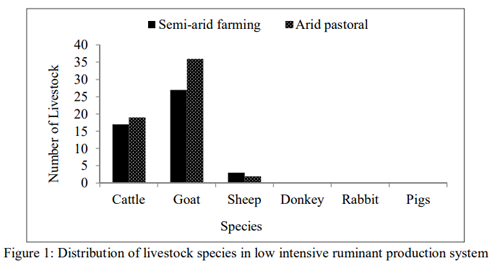
The Status of Livestock Production Systems in Semi-Arid Farming and Arid Pastoral Agro-Ecological Zones in Kitui County, Kenya1 Kivunzya, A. Ndungwa, 2Kanui, I. Titus, 2Amwata, A. Dorothy Corresponding author Abstract A cross-sectional study was conducted with the aim of describing livestock production systems in semi-arid and arid pastoral agro-ecological zones (AEZ) in Kitui County. Sample size of 110 households were calculated and distributed proportionately. Simple random sampling was used to get final respondent. Five livestock production systems were identified. Low intensive ruminant (11.8%), low intensive mixed (9.3%) and extensive ruminant (34.5%) were primarily found in semiarid farming zone. Extensive mixed ruminant (38.1%) and non-ruminant (6.3%) were mainly in arid pastoral zone. All household kept chicken. Livestock was the main source of income in semi-arid farming zone (81.7%) and arid pastoral zone (79.4%). Rabbits (6.3%) and pigs (0.9%) were the least species kept in the study area. From the study, livestock was the main source of income with different livestock production systems existing in different AEZ. There is need to empower respondents to improve livestock production in relation to their AEZ. Key words: Livestock, Production, Systems, Kitui Introduction 1.0 Background In Kenya, approximately 80% of the total land mass is arid and semi-arid land (ASAL) with about 10 million people with the lowest human development indicators (Rok, 2007; RoK, 2008). The ASAL areas are characterized by low and erratic rainfall. Most people are poor and marginalized, with over 60% living below poverty line, subsisting on less than a dollar per day, hence 2 to 4 million people receive food aid annually (RoK, 2008: Amwataet al., 2015). The livestock subsector contributes to the food and cash needs of the farmers, providing 50% of the agricultural labor (RoK, 2008), 7% to the GDP and 17% to the agricultural GDP (RoK, 2008). Therefore, if the living standards and food security are to be improved in ASAL areas, then livestock productivity must be increased (Nyariki et al., 2009; Amwataet al., 2015). This is because to enhance food situation, livestock is a key potential sector as documented in the countries blue print Kenya’s vision 2030. However, livestock farmers face a number of challenges (Kavili, 2013) which were attributed to institutional framework by the central government (Kavili, 2013). With the inauguration of the new constitution 2010, livestock sector and its functions were devolved and subsequently Kitui County got an opportunity to realize its own livestock production potential. Kitui County is an ASAL County with 63% poverty levels (RoK, 2010. Thus, there was need to devise, appropriate interventions and measures to ensure enhanced livestock production for a sustainable economy and improved livelihoods. However, there was limited information on livestock production systems in the County. 1.2 Purpose of the study To characterize livestock production systems in two major agro-ecological zones in Kitui County 2.0 Methods A cross-sectional survey was undertaken in two different agro-ecological zones in Kitui County. The semi-arid farming zone in Kyangwithya East and the arid pastoral zone in Mutomo Ward. Both livestock keepers and non-livestock keepers were included. Households were the sampling units. Sample sizes of 46 households in Mutomo Ward and 64 households in Kyangwithya East Wards were obtained proportionate to size. Simple random sampling was then carried out to select households to be interviewed. Semi-structured questionnaire were used to collect data on household sizes, livestock holdings, livestock production systems, livestock cash income, land size and types of livestock kept. A reconnaissance survey was carried out to pre-test the questionnaire prior to the study. The data was entered in SPSS software and descriptive statistics done. Household size was standardized to Adult Equivalent (AEs) while livestock holdings were standardized into Tropical Livestock Units (TLU).The data was evaluated with a view to characterize different production systems in the two study areas. The study protocol was approved by South Eastern Kenya University and consent sought from the respondents. 3.0 Results and Discussion 3.1 Number of Household interviewed A total of 110 households where interviewed; 58% from semi-arid farming zone and 42% from arid pastoral farming zone. Generally, goat was the dominant livestock species in the study, compared to other ruminants while rabbits and pigs were rarely kept across all livestock production systems. These findings were similar to a study done in the South Eastern dry lands of Kitui and Makueni (Kanui et al., 2016) where emerging livestock species were rarely kept. Poultry was an important species kept in all households visited. This agrees with other studies (Mwobobia et al., 2016) who reported that indigenous poultry where kept by all respondents in Katulani district in Kitui. 3.2 Livestock Production Systems Livestock production has been classified in different areas based on the agro-ecological zone, farm sizes, integration with crops, intensity of production and type of product (Sere and Steinfeld, 1995; Kyalo 2009). However, in this study, livestock production was classified based on the species of livestock kept, TLU holdings, mode of feeding/intensification and intensity of stocking. Five production systems were identified: low intensity ruminant production (11.8%), low intensive mixed species production (9.3%), extensive ruminant production (34.5%), extensive mixed species (38.1%) and non-ruminant production system (6.3%). Poultry were kept across all production systems while bee keeping was practised by a quarter of the respondents. 3.2.1 Low Intensive Ruminant Production System This system was reported by 11.8% of the respondents. Cattle, goats and sheep were the main livestock species kept. Of these, 61.5% were from semi-arid farming zone while 38.5% were from pastoral arid farming zone. Respondents had small land sizes compared to other production systems at an average of 5.9 hectares with median TLU of three and range of 1 to 8. This was slightly higher than that of low intensive mixed production system and lower than the other production system. More than half of the cattle (52%) and sheep (60%) were found in semi-arid farming zone while goats (57%) were found in pastoral arid farming zone. Stocking rate was 2.23ha/ TLU. Livestock were fed in stalls with farmers purchasing supplements for their livestock. However, the average expenditure was Ksh.1881 per household per year, 2.5 times less that of low intensive ruminant production. Artificial insemination was the main breeding method (84.6%) and was only used in this system as compared to others. Productivity per hectare was 879 ksh/ha/month while productivity per person was 991 ksh/month/AE. Farmers had easy access to water at their compound during rain seasons. However, during dry season, they travelled an average of 40 km to get water. Among the respondents practising bee keeping, 6.45% were found in this system. Figure 1 shows distribution of species kept in low intensive ruminant production system in the study area.
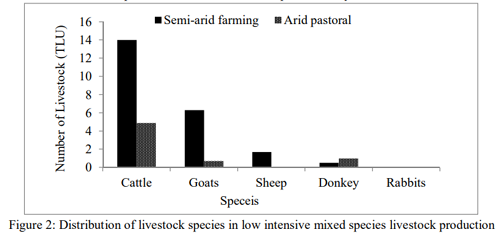
3.4 Low Intensive Mixed Production System Under this production system, farmers reared different livestock species like cattle, goats, sheep, donkey rabbits, bees and pigs. The system was practiced by 9% of the respondents, of which 80% were from semi-arid farming zone and 20% from pastoral arid zone respectively. The average TLU was 2.8 with a median of 2 and range of 1 to 7. Average land size was 0.3 hectares slightly higher than that of low intensive ruminant (6.2 hectares). Farmers fed and supplemented their livestock indoors similar to low intensive ruminant. However, in this system farmers used bulls for breeding. Mean expenditure on livestock supplements was high compared to low intensive ruminant production system; at an average of Ksh.4, 845/month. Like in low intensive ruminant production, productivity was low 568ksh/ha/month with a higher productivity per person of 912ksh/month/AE. However, stocking rate was at 3.125/ha/TLU which was lower compared to that of low intensive ruminant production. Rabbits were reported only in this production system by two respondents. Percentage of bee keepers was 6.45% of all the respondents in the two study areas similar to that of low intensive ruminant production. During dry seasons, they travelled a distance of an average of 40 km to get water. It was noted that, both low intensive ruminant and low intensive mixed systems were concentrated in semi-arid farming zone, however, productivity per person was higher than productivity per hectare. Stocking rate was low. Respondents in low intensive ruminant and low intensive mixed production used little resources to purchase supplement for their livestock. This in turn lead to low income returns. Bee keeping was not a major practice in the two systems. Figure 2 shows distribution of livestock species in low intensive mixed production system.
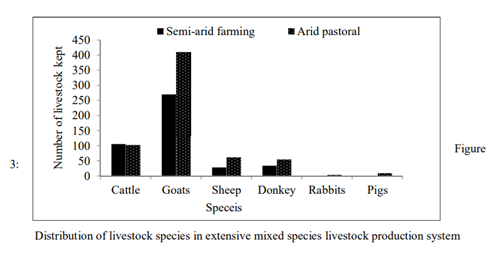
3.5 Extensive Mixed Production System This was the main livestock production system in the study area and was practiced by 38% of the all the farmers among which 61.9% and 38.1% were from arid pastoral and semi-arid farming zones respectively. The system was characterised by different livestock species namely cattle, goats, sheep, donkey, rabbits and bees. Livestock in this system grazed in the fields with standing hay/grass and dry leaves as their main feed component. The mean TLU was highest in this system at 7.8 with a median of 6 and a range of 1 to 31. This was more than other livestock production systems described above. This was similar to a study in Njoro Kenya where mean TLU in extensive system was (5.216), 5 times higher that of intensive system (1.065) (Kyalo, 2009). Average land size was equal to that of low intensive mixed production system. Stocking rates of 0.693 ha/TLU were recorded and this was unexpected and difficult to explain. This contrasted to a study in Njoro Kenya where extensive systems had large land size as compared to intensive and semi-intensive system (Kyalo, 2009). Unlike low intensive ruminant and low intensive mixed production, productivity per area was high at 1742 ksh/ha/month compared to productivity per person at 931ksh/month/AE. Majority, (95%) of the respondents never supplemented their livestock. Donkey was an important species as reported by 94.9% of respondents in this system. Bees were kept by 35.5% of the respondents of which over 70% were from arid pastoral farming. Only one respondent kept pigs in this system. Figure 3 shows number of livestock kept in extensive mixed species production system.
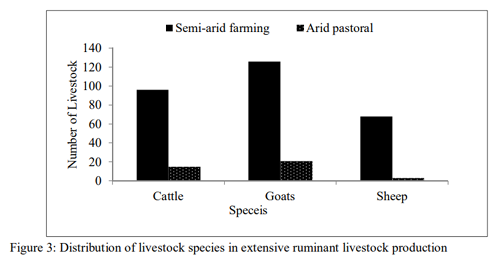
3.6 Extensive Ruminant Production System This system is the second most practiced after the extensive mixed production system. Cattle, goats and sheep were the main livestock species kept. The system was practiced by 34.5% of respondents among which, 78.9% were from semi-arid crop farming zone and 21.1% from pastoral arid farming zone. The average adult equivalent was 4.7±1.8. The mean land size was 5.9 hectares. Primarily, farmers use bulls for breeding (81.6%). Livestock grazed on standing hay. The average TLU was 3 with median of 3 and a range of 1 to 12. This was 50% less that of extensive mixed livestock production system. Stocking rate was 1.74ha/TLU, twice that of extensive mixed production system but smaller than low intensive ruminant and low intensive mixed systems. Productivity per area was 978ksh/ha/month and productivity per person of 663.2ksh/month/AE Almost half of the bee farmers (48.3%) were reported in this system among which 80% were found in the semi-arid farming zone. Figure 4 shows number of livestock in semiarid and arid pastoral farming zones
3.7 Non-Ruminant Production System In this system, respondents kept free range indigenous chicken as the main livestock. The system was practiced by only 6.3% of the respondents among which two thirds were from arid pastoral farming zone. The mean land size was 6.59 hectares. This system had the lowest stocking rate (22ha/TLU). Land productivity and productivity per person at 232ksh/ha/month and 51.9ksh/month/AE respectively. Only 3.2% of the respondents kept bees. 4.0 Conclusions Livestock is the main source of livelihoods in Kitui County. In semi-arid farming zone, three different production systems were evident that is; low intensive ruminant, low intensive mixed species and extensive ruminant production systems while extensive mixed production system and non-ruminant production system were the main production systems in the arid pastoral farming zone. However, maximum livestock productivity has not been reached across various livestock production systems. Goats were kept in large numbers across all farming zones while donkeys were primarily a species in the arid pastoral farming zone. Bee keeping and short cycle species were less popular compared to poultry which were kept by most respondents in the study area. 5.0 Recommendations The study recommends that farmers be sensitised and empowered with the aim of improving livestock production systems for maximum productivity. Also, diversification of livestock farming with a focus to short cycle livestock and improved poultry farming. Acknowledgements County Director of Veterinary Services for permission to undertake the study Farmers in Kyangwithya East and Mutomo Wards for making the study a success References Amwata D. A., Nyariki D. M., and Musimba N.R.K. (2015). Factors Influencing Pastoral and Agro- pastoral Household Vulnerability to Food Insecurity in the Drylands of Kenya: A Case Study of Kajiado and Makueni Counties. Journal of International Development DOI: 10.1002/jid.3123 Kanui, T. I., Kauti, M. and Murangiri, M. R. (2016). The Status of Livestock Livelihood Support System in the South Eastern Dry lands of Kitui and Makueni Counties, Kenya. International Journal of Livestock Research, 6 (4), 73-82. doi: 10.5455 /ijlr. 20160322124111 Kyalo, D. K. (2009). Impact of policy and social economic factors on spartial distribution of livestock production system in River Njoro watershed, Kenya. ResearchGate, https :// www. Researchgate.net/.../254386266 Mwobobia R. M., Amwata D. A. and Kanui T. I. (2016). Comparing production characteristics of poultry farmers in Katulani District, Kitui County, Kenya. Livestock Research for Rural Development. Volume 28, Article #93. http://www.lrrd.org/lrrd28/5/mwob28093.html Republic of Kenya (2010). Agricultural Sector Development Strategy 2010-2020. Government Printer Nairobi. Republic of Kenya (2008). Ministry of Livestock Development, Sessional paper No.2 of 2008 on National Livestock policy. Nairobi. Kenya Republic of Kenya (2007). National Policy for the Sustainable Development of Arid and Semi-arid Lands of Kenya. Office of the President, Special programmes, Nairobi Sere, C., and Steinfeld, H. (1995). World livestock production system: Current status, issues and Trends. FAO, Animal Production and health paper 127, Rome.
|
ISSN: 2411-5681 Online & Print Journal Information
Frequency: Monthly
News Attention to Authors The latest issue |
|
Copyright © 2013-2026 IJER - International Journal of Education and Research. All Rights Reserved • Privacy Policy |