|
Published by Contemporary Research Center CRC Publications |
 |
|
|
|
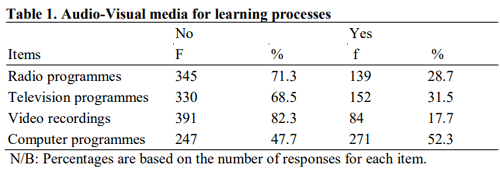
The Role of Integrating Audio-Visual Media to Teaching and Learning in Public Primary Teacher Training Colleges in KenyaAlice Omariba Abstract The paper dwells on the role of integrating audio-visual media to teaching and learning. The rationale is based on the view that properly designed media add value to a teaching environment. Integrating audio-visual media can bring exciting curricula based on real-problems into classroom; provide scaffolds and tools to enhance learning in teacher training colleges in Kenya. This is because Teaching is becoming one of the most challenging professions in the society where knowledge is expanding rapidly. As new concepts of learning evolve, teachers are expected to facilitate learning and make it meaningful to learners rather than just provide knowledge and skills. These challenges require teachers to continuously retrain and acquire new knowledge and skills in media. The researchers in this paper envision a future in which public primary teacher training colleges have complete transformation from “old age” to the information age, a future in which media is integrated throughout society in general. Introduction The need for change in the instructional methods in teacher education has been felt throughout Africa. Integration of audio visual add a new dimension to the instructional process. The national policy of the Kenyan government after independence was to promote equality and social justice. The priority was to quickly train Africans to fill high level positions left by former colonial civil servants. Lecture method of instruction and rote memorization of lecture notes by learners were a quick method of training doctors, nurses, environmentalists and other cadres of scientists to fill vacant positions. Teacher training colleges require innovative methods of teaching that encourage problem solving. To keep abreast with changes in the teaching and improve quality of instructions, integration of audio visual will demonstrate mastery of practical skills and innovation. Background to the study In the twentieth and twenty first centuries, more significant changes have already occurred or will occur than have taken place in any similar period in history Hung (2006). These revolutionary changes demand that the teachers and students use audio – visual resources in teaching and learning. In the history of classroom teaching, audio-visual resources can be classified as Audio, Visual and audio-visual. Audio materials include radio programmes, language laboratories lessons, tape and disc recording, telephone lessons, telecture and sound distribution systems programmes. Visual materials include illustrated books and self-instructional Materials, Pictures, Photographs, Flash cards, Flip books, Charts, Maps, posters, exhibits, bulletin boards, Magnetic boards, flannel graphs, dioramas, models, Mock-ups, filmstrips, slides, transparencies, silent films, chalkboards, drawings and cartoons while audio-visual materials comprise of Television programmes, films (8mm, 16mm,35mm), videotapes, sound films trips, printed materials with recorded sound, study trips and demonstration. Jean – Piaget (a) Swiss psychologist argues that; the more a child has seen and heard, the more he or she wants to see and hear... “When these audio-visual materials are effectively used in the teaching and learning process, they have the following advantages. They heighten motivation for learning thus the lesson becomes emotionally stimulating as well as intellectually rewarding, they provide freshness and variety thus provide students with experiences that are fresh exhilarating, delightfully new and varied, they appeal to students of varied abilities and that is why Hoban (1962) supports Piagets’ whereas Garrison and Kanuka (2004) suggest that a truly blended learning environment “represents a fundamental reconceptualization and reorganization of the teaching and learning dynamic, starting with various specific contextual needs and contingencies…” If this suggestion is true, then the role played by technological literacy is crucial in teaching and learning within blended courses. Perhaps the most successful approach to integrating technology into pedagogy is the creation and utilization of the audio-visual media. According to Chan, Chin, Nagami, & Suthiwan, (2011) the use of audio visual media stimulates changes in the learning environment making the learning process more responsive and meaningful to the specific and localized needs of the learner. The audio-visual media encourage active participation in the learning process as students heighten their sense of involvement by engaging in stimulating, provocative discussion, allow children to make immediate use of their learning as they apply it in meaningful ways to new situations and unexpected events hence making involvement inevitable, they give needed reinforcement such as the programmed instruction and computers which provide many ways in which a learner is rewarded by finding out how well he/she has learned, they widen the range of students experience, assure order and continuity of thought especially if it is a well-prepared television program, motion picture or filmstrips, will present the subject matter in a logical, carefully structured fashion and finally, audiovisual resources improve the effectiveness of other materials as they provide a rich variety of sensory experience to amplify and reinforce the concepts that have been presented in a textbooks. Ledford & Sleeman, (2000) observes that the use of audio-visual materials is very important whereas Dale (1969) argues that through meaningful diversity of instructional methods help the child to develop meaningful concepts. Focus of the study How audio-visual media conceptualize genuine learning. Properly designed learning materials add value to a teaching environment in which contact hours are limited (Omariba, Ondigi and Ayot, 2016; Moore et al. 2003). A key reason to use instructional media is to realize effective and balanced learning. According to Court and Kinyajui (1985), effective learning begins with first-hand or concrete experiences and proceeds towards more abstract experiences. They should help develop underlying thought process such as critical thinking, analysis and problem solving. In schools today where the use of audio-visual media has been enhanced, there are qualified staff and students have a positive attitude; there is meaningful teaching and learning taking place. Schools such as Mangu High, Alliance High, Nairobi primary, Genesis primary and Strathmore have embraced media and are outperforming rural schools without the facilities, teachers or technical know-how. Audio-visual media help to conceptual genuine learning…(Eshetu, 2015). Translated to classroom, this means that the success of an instructional representation, any device used in teaching and learning will depend to a large degree on the imaginative involvement that it can produce in students. Whether the teacher holds a demonstration or organize a study trip or play a recording, it should be remembered that students do not learn merely by looking and listening; they learn by becoming creatively involved (Omariba, 2016) as shown by Table 1.
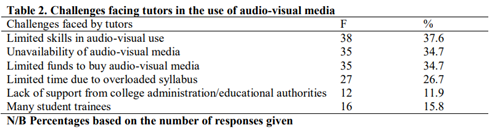
Table 1 shows how audio- visuals are used where 271(52.3 %) use computers programmes whereas other audio-visual media have minimal percentages. This clearly shows that when there is crank to turn, a swatch of materials to touch and feel, the learning can be increasingly meaningful. For instance, the motion picture is a viewing experience, a seeing and hearing experience when students watch a film, they are not directly involved with experiences of touching, tasting handling or feeling. They watch an event and can become involved only in an imaginative way because they are seeing other people doing things. Further motion pictures can reconstruct events or historical things with such a dramatic intensity, with such realism and poignancy that even the slowest student will react to the message presented and gets new meaning (Omariba, 2012). However, from the observation schedule, 100% result showed that there were no motion pictures in teacher training colleges. The findings concur with Kadzera (2006) study which looked at the use of instructional media in five teachers training colleges in Malawi and established that lack of these resources contributed to their minimal use in teaching and learning. For tutors to use audio-visual media in their teaching; it is imperative for the technology to be made available. Even though teaching materials can be substituted or improvised to deliver the same message, there are some media that cannot be improvised or substituted such as computers and projectors. Live television broadcast of a real event is history in the making, history unfolding with the outcome uncertain. Because it brings this impact of immediacy, television in this respect, as close as any mechanical device can get to the direct experience itself. With its wide messages, captioning for the hearing challenged students to understand, it brings the abstractions at the pinnacle of the cone of experience as Dale (1969) urges, thus brings about a unique value base on the feeling of realism however Table 1 shows 152 (31.5%) use of television for learning process. Audio-Visual media help students to see an idea, event or a process. Dewy (1958) says that it is the deposit of an idea, students who understand charts, graphs, maps and diagrams use such symbolic deposits. Audiovisual media in this case become abstraction that compress rich meaning. Sensory experiences are mixer and interrelated. When students are fixed to a speaker on television they may think they are getting only aural experiences, but they are also “reading his or her facial and bodily expressions---“. This means that varied types of experiences should be provided in the classroom. Audio-visual media at all levels can help extend the web of relationships that concepts are involved. Even the most advanced students therefore, can deepen his or her understanding of concepts and enjoy life through participation. The selection of audio-visual media therefore should depend on the amount of sensory experience a teacher wishes to provide for a topic of his or her lesson. Hoban (1962) observes that “Media” are not one-dimensional. Books include pictures language, music and ambient noises. Filmstrips included pictures and print.” Many instructional materials are used to help the students conceptualize their experiences so that they can deal with them effectively. The more numerous and varied the media employed, the richer and more secure will be the concepts developed (Chan, Chin, Nagami and Suthiwan, 2011). Well-chosen versatile instructional materials provide a variety of experiences that enhance learning of a given subject for any student at any given point in their continuing development. May (1963) observe that films and other graphic materials of qualities have proved to have value for instruction at all grade levels and certain parts a great many school subjects. Wamalwa and Wamalwa (2014) supports a general conclusion that properly prepared audio-visual media can help teachers teach their subject matter with increasingly effectiveness at all levels of learning hence making them confidentially as part of modern educational system. Further, the effectiveness of three-dimensional model will often depend on the maturity level of the learner, Hung (2006). Instructional television can provide instruction in various ways throughout the curriculum in subjects such as Science, Mathematics, Social Studies and subject matter areas where the teacher requires special help such as Physical Education, Music and Art. According to Schramm (1962) the average student is likely to learn as much as from a television class as from ordinary classroom methods; in some cases, learn more or less, but the overall verdict has been no significant difference. Further, one should not conclude, however, that there is a simple relationship between age or grade level and attitude. Rather, there is considerable evidence that attitudes tend to be specific to subjects and teachers. Therefore, the effectiveness of audio-visual media depends on the systematic integration of the material and the teacher’s regular instruction. It also depends to a considerable extent on the quality of the media that are presented, quality of the programmes and the teacher’s skills in evaluating and utilizing its various instructional technologies (Ngure, 2014). Films are also able to convey the information, the specific experiences, and the details that are essential for the development of workable concepts. If the teacher uses convention and classroom procedures, will make them probably more effective in teaching more complex skills than in teaching the simple ones. Hence conveying factual information and fostering important skills which provide the foundation for meaningful ideas about experience. The use of films too, help students understand the important process involved in scientific problem solving, they modify motivations, interests, attitudes and opinions, through emotional stimulation and vivid appeals to the senses of the observer, they also strengthen or challenge his or her beliefs and perceptions. Allen (1960) provides a provocative suggestion; “Films can teach factual information effectively over a wide range of subject matter, content, ages, abilities and conditions of use. The factual learning however tends to be rather specific to information communicated by films.” Whereas Wendt and Butts (1962) concluded that; “Teachers can save time and improve instruction by using films.” In as much as audio-visual media help to conceptualize genuine learning, there are cases where they don’t promote genuine learning and therefore inhibit meaningful learning as observed in primary teachers training colleges. A study by (Omariba, 2016) established that power inhibits, too much light in the room without curtain, make pictures on television unclear and this makes students to ask a lot of questions in the process of viewing, hence concentration is inhibited. Sometimes films shown are outdated, not audible or content not related to modern times. Moreover, pictures can be too small, blurred, lacking in clear details and stereotyped. Media MUST be larger to have impact. Reproduction is poor, too grainy, and fuzzy, out of focus, washed-out colours, too contrasting hence no meaningful learning takes place (Ambuko and Odera, 2013). Gitau (2009) noted that audio-visual materials are easy to hear but not easy to listen for comprehension. In the study, 70% of the students just listened for relaxation and enjoyment. Some critics warn on the danger of learners’ passivity when television is used. Further, television like film, radio and much college lecturing are usually a one-way communication. Television moves ahead at a constant speed; one can’t scan a television program as would a book. Mussein a child Psychologist was quoted saying” How much is the television a socializer? Whereas Dale (1969) observes that in as much as audiovisual media hold great promise in achieving liberal education and sustain attention, however, specifics do not automatically turn into generalizations. Some recorded messages are not accompanied with visuals hence inhibit the learning of hearing impaired students thus rendering them meaningless. Development of these audio-visual media can be time consuming, so it makes the lecturer not to cover the syllabus especially in the teacher training colleges where the syllabus is broad and not to mention other calendar activities which must take place without interference such as Teaching Practice (Omariba, 2016; Gode, 2013). The sound and audio tape may get out of synchronization wholesome, sound traps do not contain a beep signal to warn the teacher and student when through with that slide or proceed hence leaving the teacher and student stranded. The use of audio-visual media help provide contexts in which ideas can be conventionalized, tested and talked about even though tutors have poor attitude towards their use. Hoban (1962) notes that single methods or a single medium of instruction will not suffice even if only because it will become unbearably monotonous. Variety among instructional media seems to be more efficient than a monopoly of one. There is a reason to believe that media are complementary not competitive and that a combination of media in the instructional process is superior to anyone alone. Do Audio –Visual Media assist students in primary teacher training colleges achieve curriculum goals? The systematic resigning and reintegration of instructional material has taken hold in certain fields of the curriculum (Grabe and Grabe, 1998). Wagner (1961) observes that “it is the fulcrum, in which the balance of the whole educational system of the future may rest, from buildings to books, from the teachers to the teaching machines, from curriculum to classroom.” Studies show that there is accumulation of knowledge faster than education can evaluate and distribute it. The problem has arisen because the rising demands for improved education have not been matched with modernized technology of communication (UNESCO, 2012). The knowledge gap between the informed and the uninformed individual may grow even greater a hardous situation in democracy built on the assumption of equality of opportunity, of shared power and shared respect. The curriculum developers have neglected to bring the whole segments of population young and old, into close touch with the knowledge values, skills and abilities needed in a complex world, hence the importance on the continuing development of new materials and new modes of instruction in all - subjects all of which are using increased amount of films, recordings, filmstrips and other technological devices. Finn of the University of California has pointed out that education as a sector of national life has for the most part been off from the technological advances enjoyed by industries, business, military establishments. The American educational enterprises exist out of technological balance with great sectors of the society (CNEA Journal November 1960). In essence, the use of audio visual media in schools and colleges aims: i) to change the role of the teacher so that he can put increased emphasis in learning process which requires close personal relationship with students, ii) to design learning and teaching environment in which the learner has more self-direction in the management of his own development. Instructional technology does not explain what the broad goals of education should be (Omariba, 2016). It does, however, furnish us with a means to reach them. However, this is not the case in PPTTC institutions. The study established that tutors are faced with challenges when using the available audio-visual media as shown in Table 2.
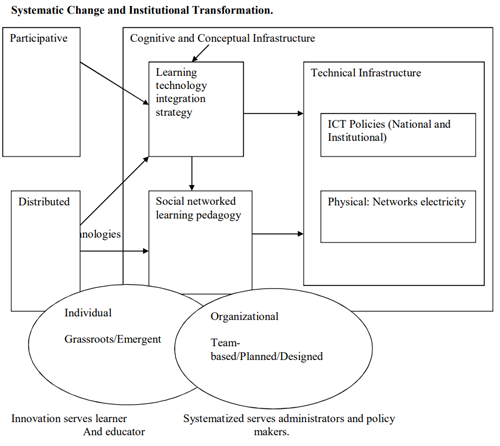
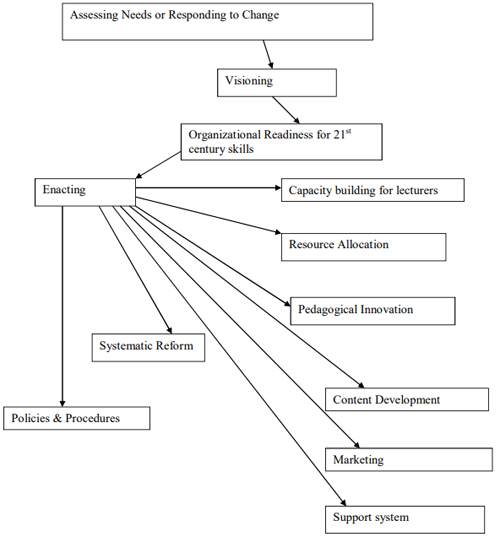
Audio-visual materials help students achieve curriculum goals, but this is not the case in Primary Teachers Training College, which has a variety of audio-visual materials, but which do not help students achieve curriculum goals because of several challenges faced by the tutors and students to achieve curriculum goals. Abdo and Semelea (2010) argue that the availability of media is a critical factor in determining the frequency with which teachers use the media. The teacher training curriculum is too broad. This makes it difficult for a tutor/s to have enough time to use audio visual resources within a lesson of one hour. Siddiqui (2004) notes that even without educational technology, classrooms are already drowning in data and overcrowded curriculum puts students and teachers on the brink of intellectual indigestion. Adding additional informational, multimedia bells and whistles is likely to worsen rather than improve educational setting. The resources are not availed to students to use during their free time. The computer laboratories are inadequate with inadequate computers to be shared among the first and second year students; hence exposure (accessibility) is a challenge. Some tutors have poor attitude towards the use of audio – visual media. The researcher noted that most of them lack technological know-how, so they shy off from using them as shown in Table 2. The use of Overhead Projector, computer power point in teaching and learning and use of computer in timetabling needs technology which most of them lack. The colleges are lacking modern audio-visual media. According to Bitner and Bitner (2002), the availability and access of audio-visual media and technical support were critical for determining the frequency with which teachers used the resources to enhance their lessons. The available media are outdated and causes breakdown even in the middle of a lesson, so the few lecturers with technical skills don’t bother to use them. The study noted that the PPTTC community comprises of people of different cadres. Some of them have traditional beliefs from their grandparents that the computers will destroy them “men will become impotent” they are dangerous. This techno-phobia in some of them poses a big challenge in use. There is lack of homogeneity; students have different entry behaviors and abilities in addition poses a big problem when using technology hence this kills the morale of lecturers with technological know - how in using the audio-visuals. Hardware and software are not enough in relation to the surplus population in the college. Some topics meant for practical lessons are taught theoretically especially in applied sciences. Heads of departments have some equipment in their offices but usage by other tutors is very strict or sometimes those offices are under key and lock making accessibility impossible hence tutors’ morale is killed. The continuing cost of maintaining and upgrading a massive infusion of college-based technology is prohibited. The College Boards rapidly becomes resistive at sizable yearly expenditures for technology maintenance and telecommunications usage. For these reasons, a huge sum in information infrastructures for the colleges is impractical and invites a later backlash against educational technology thus a challenge. In conclusion, efforts should be made to assist tutors and students in the usage of these audio-visual resources which Gagne (1965) summarizes that; That arrangement of people conditions which is needed to bring about the changes in the human individual, attributable to the process of learning which transform him from a dependant child to a productive adult member of society--- there should be systematic redesigning and reintegration of instructional materials. ‘’The technology used instruction therefore, should be a boon to education, not a danger.” Audiovisual media can help provide every person with access to excellence (Wamalwa and Wamalwa, 2014). They make individualization manageable. How “Technologizing” of education is helping to promote learners” involvement. According to Ball (2012), assistive technology can facilitate access to learning material by bridging the ‘access gap’ between the material and the learner. The materials may not have to be altered if they have been designed appropriately and if the learner can access them using suitable assistive technology. Unhappily the term “technology” to some suggests a world of whirling gears, tools and machinery, an assembly line, time clocks, computers, depersonalizations. Indeed, to some teachers, administrators and curriculum specialist consider technology only as “machine.” This is why in most schools and colleges once one talks of technologizing the teaching and learning, it is received with a low profile (Omwenga, 2004). Clearly, technology is not a machine it is a planned systematic method of working to achieve planned outcome - a process not a product. In this 21st Century, more educational changes have already occurred will occur than have taken place in any similar period in history. The new curriculum demands more thinking by tutors and students and will result in less deadening routine. Further, there is a greater range of choice of instructional materials. Translated to classrooms, this means that the success of an instructional presentation-any media depends to a large degree on the imaginative involvement of the learner. Beard (1955) viewed technology as a major force in society. He notes; …narrowly viewed technology consists of the totality of existing laboratories, machines and process already developed, mastered and in operation. But it is far more than objective realities… technology has a philosophy of nature and method: an attitude toward materials and work and hence is a subjective force of high tension. It embraces within its scope great constellations of ideas, some explored to apparent limits and other in the form of posed problems and emergent issues dimly understood. This means that technology has brought people into closer contact with a reproducible reality. It enables learners to see the world more clearly, more accurately, to be able to turn to a “copy” of an event so that all persons could at least be talking about generally the same image. For instance, when they use a computer to download information from the internet on various subjects of interest, they get to know the world and understand what other learners are doing a round the world hence, they become more exposed and knowledgeable. The extensive development of in expensive recordings and playback equipment, of inexpensive paperback books, of talkback radio and television, films trips together with transparencies and overlays are extremely effective for developing heightened attention and for encouraging student participation in the learning process. These modernized tools for self-instruction are increasingly available and users can now stop, repeat or replay a film for critical and detailed analysis. There is also rediscovery of the importance of oral communication as presented in motion pictures, television, disc and tape recording, video tapes which provides a choice of learning by listening, by observing or by recording. Further, transparencies with overlays are particularly helpful in fostering vocabulary development – a subject that has too often been dull and uninviting. With the use of transparencies and overhead projectors, students can be helped to become eager to learn new words. These materials show students how to build up words from foundation of roots, prefixes and suffixes. It is apparent, then that projected media has the power to evoke heightened attention and active participation in learning. They can stimulate the mental process that we have already found to be important in the contraction of fruitful generalizations. The wider use of tape recordings and film closed circuit television, of videotape for individual viewing requires changes in school or college building. This revolutionary change describes the challenge role that the teacher faces in using the new instructional methods and materials. Reed (1962) observe: Give the teacher all the tools he needs to teach effectively”. This implies that student teachers should be exposed so that they may acquire skills which will make them effective in their delivery in the field once they graduate. To carryout Paul Reeds suggestion, systematic approach is required for the selection, cataloging, distribution, utilization, upkeep, evaluation and production of instructional materials. Hence specialized personnel must be developed and fitted into the school system. Instructional technology is developed therefore as “a way of matching the desired ends with the effective means. Audio-visual materials are an integral part of a unified system of instructional (Dale, 1969) and educators must develop sophisticated techniques of analysis and evaluation whereas Hierarch (1966) states that “The division of instruction into mediated and classroom permits three broad tactical choices” a). The classroom teacher can choose such media as she wishes (b) there can by systematic plans for the best combination of teacher and media or (c) a person can learn from media alone as in total teaching with television. d). Further, there are common aspects of achieving accessibility in audio-visual materials. A teacher to ensure that: materials are clear, consistently organised and explanatory; information contained in visual elements (such as images, video and text) can be accessed without needing vision for cases for learners with visual impairment; information contained in auditory elements (such as video or audio) can be accessed without needing hearing for cases of learners with hearing impairment; display elements can be modified to suit users’ needs (such as magnification, colour contrast); tasks can be performed without needing rapid text-inputting skills, manual dexterity or visual acuity(The OER network Open Washington , 2017). Meeting these requirements does not mean that you have to avoid using elements that some people cannot access (e.g. video), but rather that a teacher ensures that the information conveyed can be accessed by everyone(Including learners with disabilities). This can be done by making it available in different ways or through different media (Open University, 2021). This implies that changes in technology of communication make possible profound changes in curriculum and methods of instruction –printed textbooks have made many oral explanations by teachers less necessary. New inexpensive paperback enables both the regular and challenged students to build their own classic libraries in various subjects of interest. Some people say, that motion pictures, videotapes, or recordings do not teach; but if they mean that to teach or to instruct is to convey ideas, present instruction, develop tastes, then certainly they do teach. For instance, the Kenya Institute of Curriculum Development (KICD) Educational radio programmes are well organized, follow the syllabus, have planned time such that with or without a teacher, students can follow the timetable and get instructions from the radio teacher, Bahari ya Lugha from Radio Citizen every Saturday at 9.00a.m teach very good Kiswahili grammar and Fasihi; further Citizen Television have programmes such as “Know Zone which grammar, spelling and storytelling, Mathematics, Social studies and so on to learners, Maswali kwa Wanafunzi for secondary schools programmes are good. This is evident that technologizing of education indeed promotes learners participation and involvement in various ways. Television for instance, is promoted for distributing many media – such as motion pictures diagrams, charts, filmstrips, photographs and so on while television videotaping can provide monitoring of the teachers actions, (posture, gesture, facial expression) improvement of teaching strategies playback in skill training detect in performance, aside view of oneself which a mirror could not show or storage of any television program for replay for view or showing at a more suitable time. In addition, technology furnish one with especially effective way to extend the range of vicarious experience. For instance, most students and teachers cannot travel to the Veldt of Africa, but they can learn about it through a film. Thus, through the skillful use of radio, audio recordings, television, video recordings, painting, live drawing, motion picture, photograph, model, exhibit, poster, the world is brought to the classroom. The motion picture is a viewing experience, a seeing and hearing experience. When students watch a film, they are not directly involved with experiences of touching, tasting, handling or feeling. They watch an event and can become involved only in an imaginative way because they are seeing other people do things. They can also reconstruct events /historical things with such a dramatic intensity with such realism and poignancy that even the slowest child will react to the message presented and get new meaning. Live television broadcast of a real event history in the making, history unfolding without come uncertain. It brings this impact of immediacy, television is in respect as close as any mechanical device can get to the direct experience itself. With its wide messages, it brings the abstractions at the pinnacle of the cone of experience hence brings about a unique value base on the feeling of realism as Dale puts it in his cone of experience. All these are clear indications of how education has been technological and indeed impact on both teachers and learners. In summary, this is an industrial society in which modern inventions (technology) seem to have created educational problems faster than can they solved. But the same industrial society has also provided the means for solving problems. Some of the means include computers, programmed instructions in expensive paperback book, radio recording, pictures and television. All these are means and ways of technologizing education even though it is received with a low profile and teachers and students are faced with a myriad of challenges as discussed earlier. How audio-visual technology can be used to expand access, equity and education for All The future task of the teacher becomes more complicated, more challenging, more professional, worthier of respect using technology (Stensaker, Maassen, Borgan, Oftebro and Karseth, 2007). This is because the curriculum demands more thinking by teachers and a greater range of choice of instructional materials; whereby instructional technology does not tell teachers what the broad goals of education should be because of this, individual guidance in the higher mental processes becomes a reality (Omariba, 2016). The development of critical and creative thinking requires a teacher who is sensitive to the experience of the youngsters at the level of their concepts. Indeed, the less predictable profitable the future becomes, the more dependent on higher mental process on complicated decision. Making which requires assistance from a guide, mentor, skillful organizer and critic know - how is not enough. There must also be the know -why and know-when; and it is here that the most important work of the teacher can be done and if not, then audio-visual media cannot be considered apart from educational purposes and curriculum objectives. The methods (methods and materials) and ends (Educational goals) must not be separated. Solutions and Recommendations Clarity of Objectives The use of audio-visuals brings revolutionary changes in teaching methodologies. The innovation lies not per se in the introduction and use, but in its role as a contributor towards students-centered form of teaching and learning (Smaldino, Lowther and Russell, 2012; Ogange, 2011). To achieve this; there must be clear-cut statement objectives in enough detail so that learning experience can be planned to reach these objectives. The mode of design taken should consider all the places, situations where desired learning should take place, not merely those within the walls of the school, but a key objective to the development of the independent learner the individual who has learnt how to use modern technology and who has a test for learning. The home and the school will cooperatively plan the learning for which each is directly or jointly responsible. Teachers must carefully consider attaining the new objective, the persons to be taught, the materials, methods and media for teaching and time and general circumstances under which teaching will take place. What does the teacher intend to teach, why, to whom, how, where and when? The professional teacher must be concerned with all these problems, must have some part in planning objectives, the attitudes and the intellectual abilities to be developed. Obviously not every teacher will develop his/her own complete curriculum but be an active partner in selecting the general objectives furnishing the kinds of experiences which fit the personal needs of children. The responsibility must not be abducted, but rather aim at expanding accessibility, equitifying education for all. This can be done by use of for example, motion pictures which reconstruct events or historical things with such a dramatic intensity with such a dramatic intensity with such realism and poignancy that even the slowest child will react to the message presented and get new meaning. Achieving Desired Outcomes Mass media are most influential when the messages are specific, directly related to the needs of the user, and when presented by trusted persons such as professional teachers or even by currently popular mass media “personalities”. A multiple-media campaign approach with variety in repetition with each media is likely to be more effective than the use of a single medium alone. This does not mean that these media presentations are simultaneous, they may be sequential. Norberg (1961) suggests that: It is important of course to know that television or any other medium can be used for instruction. But the knowledge of this potential immediately poses many other important questions. It is not important to know that television can teach, that films can teach, that teaching machines can teach. The real problem is how and what each device can do best for the kinds of students, under what conditions, with respect to what educational objective and in relationship to other devices and to what human resource, the teacher. Cumulative effects occur when one knows exactly what the educational goals are and use recurring experiences to provide additional information and practice. The teachers can avoid being enslaved by routine technological process if they know exactly what they need to do and how best they can do it. They must know their own role before assigning the machine. End first, then means. The challenge of education for all can be enhanced by the desirable effects of the mass media by increasing the range of free choice, improving the maturity of viewers’ reactions, furnishing opportunities for face-to-face interaction and by providing a source of information about excellent films, radio or television programmes. As new tools are added and materials to the teaching equipment of the teacher, one must maximize creative activities and minimize routine learning that can be developed through media thus expanding and accessing equitable education for all in Kenya. Dale (1969) says: “We learn good taste by tasting good things and good taste grows out of exhalating new experiences’’. For instance, visual symbols help students to see an idea, an event and process. Students who understand charts, graphs maps and diagrams use such symbolic deposits. Through this meaningful diversity of instructional methods, children to develop meaningful concepts. His or her relatively direct sense-involved learning modify and extend the range of his/ her abstractions just as Edgar Dale puts it. Proper Organization and Co-coordinating the Use of Audio-visual media Audio-visual media will be increasingly used in the testing or evaluation phase of instruction whereby all learners are presented with a visualized problem, a case and is asked to diagnose and suggest remedial treatment. Teaching time must be used effectively to increase the productivity of the teacher. This requires determination by the teacher and learners, new development in the production, selection, utilization, and evaluation of these audio-visual materials. It requires design and system if at all we want to expand, equate education for all. For instance, communication by television is effective because it can transmit a wide range of audio-visual materials such as still pictures, films, objects spacemen and drama. It is superb dissemination device for many media instruction. The immediacy gained through showing an event in progress makes it anniversary available. The concrete nature of television makes some programs understandable and appealing to a wide variety of age and educational levels. It also saves time of the teacher and student especially when teachers use videotaped presentations they eliminate the need for repeating same explanations or demonstrations of the subject matter to class after class. Most important is that television can be both instructive and enjoyable. It can provide an interesting exciting change of pace; furnish some of the variety that is the spice of education. The government Policy Equating education in Kenya through audio-visual technology requires the government to provide power to every rural school so that teachers can be able to use the audio-visual technology in disseminating content to the learners. For instance, use of power point presentation to teach some complicated science, mathematics, art and so on content more easily, students can also browse in the internet to see what other students are doing in the world of education. According to Ngure (2014), audio-visual media are designed for providing realistic images and substituting experience for reaching curriculum experiences; they are however not a substitute for the teacher or instructor. Their use call for the teachers’ initiative and imagination as they look for new ideas and techniques for delivering their lessons. Further, the government together with educational stakeholders should come-up with an action plan that audio-visual media is in-cooperated in the educational syllabus so that as teachers break down the various topics in various subjects, they are aware on which audio-visual media to use and incases of those teachers without relevant skills for the same can make prior arrangements with those with technical skills in advance so that learners are taught. In so doing, all learners from all parts and corners of Kenya will get to learn similar things and the private schools’ advantages over the public schools will be a history, the most disadvantaged child will also get what the advantaged child currently learns and the type of education in Kenya will be equal unlike what there now. This is because audio-visual materials being an integral part of a unified system of instruction, sophisticated techniques of analysis and evaluation should be developed which will be similar to all learners countrywide hence, technology of communication would have made profound changes in the curriculum, and methods of instruction. There is need for a model of planning at system level as follows.
Adopted from Socialization as information objects Connectivism and Connective Knowledge 2012 This is the system support needed in expanding the education for all in Kenya. The Teachers Service Commission to recognize the role played by educational technology teachers in education boosting their morale by giving them incentives and also recognize it as part of an educational unit so that more personnel can train on the same, go out there and assist learners to get what they deserve in education in the 21st century era as education is viewed as life. Research supports the general conclusion that properly prepared audio-visual materials can help tutors to teach the subject matter with increasing effectiveness at all levels of learning (Ngure, 2014). They can be used confidently as part of modern educational system. May and Lumsdaine (1963) concluded that “Films and other graphic materials and qualities have proved to have value for instruction at all grade levels and for certain parts of many school subjects.” These general observations drawn from the research should be of significant assistance to supervisors and curriculum specialists and the classroom teacher who is charged with the responsibility of the use of these instructional media for implementation of educational goals. The Media center contributions The school itself be of a different kind of place from what it is today where a variety of media available will be increasingly important. The old and the new audio-visual Media of Instruction to provide needed experience to children either individually and as a group. Each school each classroom can be equipped with a cafeteria of varied learning Material catering for Learners. Individual differences through better diagnostic instructions often a self-testing character student will get the educational experiences they need. DeBenadis et al. (1962) note that grouping or individual study can be related directly to the stated behavioral objectives and as a result, the terms homogeneous grouping and heterogeneous grouping will have limited general meaning. Grouping homogeneously for some subjects and grouping ineterogeneously for others. This will determine individual instruction and which the most appropriate method to use is hence both individualize and in socialize and so doing, we are trying to expand education for all. More Responsible Role for the Teacher The teacher or teams of teachers will bear increasing responsibility for planning, organizing, and evaluating the effective use of all media. They will carry out complex aspects of instruction that demand personal and group relationships and will make wide use of instructional materials that do not require the constant physical presence of a teacher hence expect the term” mediated instructor” to loom larger in instructional procedures. Teachers will also increasingly use audio-visual resources to help sensory-deprived and experience starved learners from under privileged families. Hebb et al. (1958) studied on sensory deprivation and concluded that “normal behavior depends on a normal perceptual environment,”. This means that the teacher or the team of teaches carrying out these complex aspects of instruction will face much greater professional demands than ever before and will need special information on resources not available in the instructional material center. These teachers will work together with curriculum developers and government assistance so that they may be assisted with a new kind of automated Library, storage and retrieval system that will give the teacher complete and up-to-date information on desired syllabus. That is, be able to have easy to elaborate computerized storing and retrieval systems which are not available in institutions and yet the Kenyan’s vision is that by 2030, the country should be fully developed. Reed (1962) observes “give the teacher all the tools he needs to teach effectively”. Revolutionary Change Needed According to Asian Development bank (ADB), Social and Economic development depends on the quality of human development. Education has become the number one demanded commodity for social and economic transformation for both developing and developed economies. Muyinda (2012) pointed out that educated people with relevant skills in education are competitive in a globalized world. They contribute significantly to the technological capacity and overall competitiveness of developing countries. Quality education allows economic progress, self-actualization, career advancement and acquisition of necessary skills, knowledge and attitudes. For audio-visual media to be used to expand, access, equity and Education for All revolutionary change is needed. This means that the new materials and the demands on education require sharp, important changes in our educational approaches, clearly, the Ministry of Education and Curriculum developers need to plan and work to accommodate technology in education. The future of educational technology makes great demands on the present. The task requires foresight imagination and commitment to the ordeal of access to excellence for all who want to learn. Einchholz (1963) has pointed out that need: “Faculty that are products of educational systems not yet operational. A system of curricula that educates people for positions that do not now exist. Facilities that incorporate technological systems of learning that have not yet been invented”. Certainly, many of the ingredients and techniques for this change are better said in Kenya government but not implemented. In conclusion, it is no simple matter to a teacher supervisor, a principal or a superintendent in today’s schools. The media of instruction have multiplied as have the funds to purchase them. Administrative curricula and instructional decisions must be made, sometimes on inadequate evidence. Its evident that successful development of team teaching individualized instruction, non-graded schools, earlier teaching of certain concepts, continuing education in Kenya, foreign language instruction, and other innovations depend in improved methods of communication between the teacher and the student. Technology is helping to change education. The potential downside of that, without strong leadership, not every student will enjoy technology advantages, without a wellthought-out policy in place-and without the commitment continent of fund –up to date technology in schools the interest of students, their parents and the community will not be well served. Schools will fall further the society that surrounds them. Technology is critical to preparing students to live, learn and work successfully in a digital age (Omariba, 2016). This can only be a dream come true by using and internalizing audio-visual technology in expanding accessing equity and education for All (EFA) within Kenya. Way forward if Kenyan Tertiary Institutions are to Integrate Educational Technology into their Curriculum Short of Begging for Foreign Assistance. Systematic reform involves moving from utilizing special, external resource to reconfiguring existing budgets to free up money for innovation. Without under cutting their power, change strategies effective when pioneering by leaders in educational innovations must be modified to be implemented by typical educators (Grabe and Grabe, 1998). Technology based-innovations offer special challenges and opportunities in this scaling up process. Systematic reform is not possible without utilizing the full power of high performance computing and communications to enhance the reshaping of schools yet the cost of technology is an embedment. Its rapid evolution, and the special knowledge and skills required of its users pose substantial barriers to effective utilization (Newby et al. 2003; Omariba et al. 2016). To curb this problem, the Kenyan teachers training colleges should do the following: One suggested strategy is by off-loading from classroom setting some of the burden of presenting materials and including motivation, learning activities that use the technology infrastructure outside of schools. This would reduce the amount of money needed for adequate levels of classrooms-based technology. Such a strategy also enables teachers to focus on students’ interpretation and expressive articulation without feeling obligated to use technology in every step of the process (Grabe and Grabe 1998; Moyaka, 2012; Omariba, 2016). Such a model of districted learning will involve orchestrating educational activities among classroom work places home and community settings. This pedagogical strategy models for students that learning is integral in all aspects of life- not just schooling-and that people adept at learning are fluent in using many types of information tools scattered throughout out our everyday context. Such an educational approach also can build partnerships for learning between teachers and families, this is important because parental involvement is certainly one of the most powerful levers in increasing students’ educational performance. Educational improvement based on distributed learning-utilizing information technologies external to school settings to enable increased interpretive and expressive activities in classrooms – does not mean that school won’t need substantial amounts of computers and communications. To empower project-based learning, students must have access to sophiscated information devices in schools or teacher training colleges (Newby et al. 2003; Jesse, 2016). Even if this is accomplished via notebook computers and wireless network moved from class to class as required, with students also spending significant amounts of time learning without the aid of technology, the government though districts must allocate more money for purchasing, maintaining, and up grading computers, other audio-visual devices and telecommunications than has been true historically. Further, the government can provide a way of technologizing education by working together with the ministry of education, all education stakeholders, including curriculum developers to design a curriculum where audio- visual media is inclusive. That is, work out the curriculum which included specialist in behavioral technology or instructional technologist to prepare media to help arrange for the systematic integration of varied experiences in teaching and learning process which Wagner (1961) calls “a fulcrum on which the balance of the whole educational system of the future may rest---”. The colleges through their chief principals can solicit funds from the old students and well-wishers as to enable them purchase technology gadgets to up their schools. Further, they can also solicit funding locally from the area Members of Parliament, community mobilization because the relationship between educators and the community is seldom seen as a partnership. This rapport created will create a respected role in orchestrating learners learning across a spectrum of setting. This shift is a powerful driver to innovation. To activate these bottom-up, middle out and top-down forces for improvement, educators must also take the lead in a developing a shared visit systematic reform, distributed learning and sophisticated utilization of audio-visual media. Tutors in primary teacher training colleges need to be in-serviced on different aspects of integrating audio-visual media. This is a central task in an instructional system where revolutionary change needs to occur (UNESCO 2005; Omariba, 2016). This will assist the tutors in colleges in “audiovisualizing” the college curriculum thereby providing enriching experiences to the student teachers in the college. An instruction technologist needs to be invited to assist the tutors on planning, selecting, using, evaluating and developing audio-visual media for instruction, with special attention to newer media of communication and how to keep an inventory of community resources, museums, film libraries, that the college can use. PPTCs should have a strategic plan as follows:
After the action plan, the colleges need to organize a well-stocked pool of audio-visual equipment in the Learning Resource Centre easily available for both tutors and student teacher trainees for use. On achievement, then all schools and colleges will have an instructional technologist who will have a sophisticated grasp of the systems approach, a basic understanding of communication and learning theories, a basic understanding of the taxonomy of educational objectives, an understanding of technology gadgetry, a thorough knowledge of programmed instruction, an understanding of development, use, and evaluation of material involving communication devices of various kind, a sufficient competence in the field of research design and methodology to develop and test instructional system. Thus, have an output fitting in digital era. Future Research Directions There is need for further research on integration of audio-visual in teacher training colleges to provide the student teacher trainees with the 21st century skills to have global competences in work and life. Conclusion This is an industrial society in which modern innovations seem to have created educational problems faster than it can solve them (UNESCO, 2012; Omariba, et al. 2016). The same industrial society has also provided means for solving these problems. That is bringing technology to change education (Omariba, 2016 & Jesse, 2016). This technology intended to change education is received with a low profile as tutors and students are facing many challenges in attempt to use audio-visual technologies in education (Omariba, 2016). References Abdelraheem, A. Y., & Al-Rabane, A. H. (2005). Utilisation and Benefits of Instructional Media in Teaching Social Studies Courses as Perceived by Omani Students. Malaysian Online Journal of Instructional Technology, 2(1). Allen,W. (1960):Encyclopedia of Educational Research, ed.3 Macmillan, New York buko, B., & Odera, F. (2013). Selection and use of Media in Teaching Kiswahili Language in Secondary Schools in Kenya. International Journal of Information and Communication Technology Research, 3(1), 12–18. Beard,C.A(1955): Introduction to the American Edition,”in J.B.Burry, The Idea of Progress, New York Chan, W. M., Chin, K. N., Nagami, M., & Suthiwan, T. (2011). Media in Foreign Language Teaching and Learning. Boston: De Gruyter Mouton. Dale, E. (1969): Audiovisual methods in Teaching. (3rd Edition). The Dryden press, New York Denley, J. (1958): Art as Experience: Capricon, New York Eichholz,G.C. (1963), “Three Greatest Needs,” The University of South Florida Educational Review Vol.II Fall Finn, J. D. (1960). NEA, Journal November, the American Educational Enterprises, New York Gagne R. M. (1965). The Conditions of Learning. Holt, Rinethart and Winston. New York Grabe, M. & Grabe, C. (1998).Integrating Technology for Meaningful Learning. Houghton Mifflin co. Boston Hoban,C. (1962): Research in New Media in Education “Three conference working papers (Washington D.C American Association of college for Teacher Education, PP 22-23). Hung, D. & Khine, M. S. (2006).Engaged Learning with Emerging Technologies. Springer, Dordrecht. Jesse, S. N., Jesse J. M. & Omariba, A. (2016). Effect of User Interface on the Utilization and Efficacy of Educational Digital Content among Secondary Schools in Kenya. International Journal for Innovation Education and Research, Vol: 4 (10), 225-241. Kadzera, C. M. (2006b). Use of Instructional Technologies in Teacher Training Colleges In Malawi. Virginia Polytechnic Institute and State University. Newby, T. J., Stepich, D. A., Lehman, J. D. & Russell, J. D. (2006). Educational Technology for Teaching and Learning. Third Edition. Upper Saddle River, New Jersey Norberg, K. D. (1961), “The First of the Title VII Reports A review,” A-V Communication Review July- August P.A-11 Ogange, B.O. (2011). An Analysis of ICT Policy Development and Practice in Teacher Education in Kenya between 1997-2007. Centre for Research in Education and Educational Technology. The Open University- UK Omariba, A. (2016). Teachers’ preparedness in Integrating Information Communication Technology in Training Teachers in Public Teachers training Colleges in Central Region, Kenya. Kenyatta University, Unpublished PhD Thesis. Omariba, A.; Ondigi, S. R.; & Ayot, H.O. (2016). Perspectives on Tutors’ Preparedness and Adoption of ICT in Public Teacher Training Colleges in Kenya. Journal of Education Practice 2222- 173 ISSN Open Educational Resources Network Open Washington (2017). Washington State Board for community and Technical Colleges; Washington Reed, P.W. & Gordon, K. B. (1962). Audiovisual Materials” Review of Educational Research April. (PP.42) Smaldino, S. E., Lowther, D. L. & Russell, J. D. (2012). Instructional Technology and Media for Learning. Tenth Edition. Pearson, Boston Stensaker, B., Maassen, P., Borgan, M., Oftebro, M. & Karseth, B.(2007). Use, Updating and Integrating ICT in higher education: Linking Purpose, People and Pedagogy. Higher Education 54:417-443 UNESCO, (2012).UNESCO Working Paper Series http://www.unesco.org/new/en/unesco/themes/icts/m4ed/ Wagner, R. (1961): “Design in Education”, The News Letter volume xxvii, November 1 (college of Education, the Ohio State UNIVERSITY, COLUMBS, OHIO). Wamalwa, E. J., & Wamalwa, E. W. (2014). Towards the Utilization of Instructional Media for Effective Teaching and Learning of English in Kenya. Journal of Education and Practice, (31), 140–148. Wilbur, S. (1962): Instructional Materials Media and Technology,” Review of Educational Research April (p.156). Key Terms and Definitions Audio-visual- materials comprise of Television programmes, films (8mm, 16mm,35mm), videotapes, sound films trips, printed materials with recorded sound, computers, study trips and demonstration. Integration- Is the adoption, inclusion and use of resource materials/equipment to aid the process of teaching and learning.
|
ISSN: 2411-5681 Online & Print Journal Information
Frequency: Monthly
News Attention to Authors The latest issue |
|
Copyright © 2013-2026 IJER - International Journal of Education and Research. All Rights Reserved • Privacy Policy |