|
Published by Contemporary Research Center CRC Publications |
 |
|
|
|
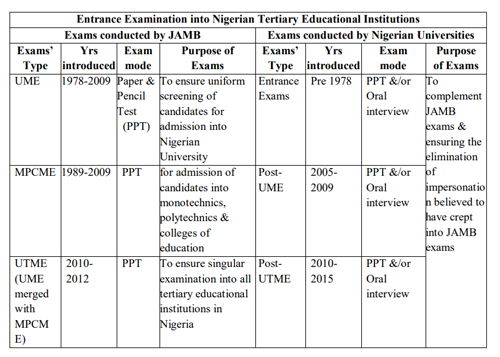
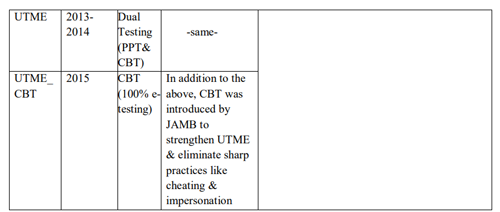
Post-Utme Screening in Nigerian Universities: How Relevant Today?Abudukadiri IKOGHODE Abstract This study investigated the relevance or otherwise of Post Unified Tertiary Matriculation Examination (Post-UTME) as conducted by Nigerian universities alongside Joint Admission and Matriculation Board (JAMB) electronic examination called UTME Computer-based Test (CBT) in admitting students into Nigerian universities. Five research questions were raised and a hypothesis was formulated to guide the study. The hypothesis was tested at.05 level of significance. A survey research design was adopted for the study. All the students and lecturers in the University of Benin, Edo State, Nigeria constituted the target population. A sample of 200 respondents comprising 150 students and 50 lecturers from two faculties of the institution responded to the instrument through simple random sampling technique. A self constructed instrument tagged, ‘Questionnaire on PostUTME Screening in Nigerian universities (QPSNU): students and lecturers’ perspective’, as validated by measurement experts was used to collect data for the study. The reliability of the instrument was established using split-half method of internal consistency of reliability and it yielded a reliability coefficient of .86. The data obtained were analysed with a statistical tool, chisquare [X2 ] to test the hypothesis. The calculated X2 value was found to be greater than the tabled critical X2 value, thus, the formulated null hypothesis (Ho) was rejected. The result from the findings revealed that Post-UTME screening in Nigerian universities is significantly different from JAMB UTME_CBT. Meaning Post-UTME is unnecessary and unfair since not of same standard with UTME_CBT. Based on the findings, one of the recommendations made was that: since JAMB has introduced UTME_CBT to eliminate sharp practices like cheating and impersonation by candidate, Post-UTME is no longer relevant. Keywords: Post-UTME, JAMB UTME_CBT, Screening Examination, Nigerian Universities. Introduction Post-UTME as currently known today metamorphosed from the term ‘Post University Matriculation Examination (Post-UME) which was introduced by Nigerian Universities in 2005 to complement the then JAMB University Matriculation Examination (UME). Discussing Post-UTME that replaced Post-UME equally means discussing JAMB UTME_CBT that was modified from JAMB UTME which changed from JAMB UME. Prior the modification of JAMB-UME to JAMBUTME and to JAMB UTME_CBT, JAMB was conducting separate entrance examinations for the various tertiary educational institutions in Nigeria. While the university matriculation examination was then termed JAMB-UME, that of Polytechnic, Monotechnic and Colleges of Education was known as Monotechnic, Polytechnic and Colleges of Education Matriculation Examination (MPCME) which was introduced by JAMB in 1989 (Exametry, 2013). JAMB introduced UTME in 2009 but the examination was first conducted in 2010 (Exametry, 2013). UTME was introduced to replace UME and MPCME and to serve as the common entrance examination into all tertiary educational institutions in Nigeria (Edukugho, 2012). The essence of JAMB UTME was to cater for all these institutions with a single examination. Prior the introduction of the then Post-UME by Nigerian universities, JAMB was solely and constitutionally given the responsibility of conducting examination and admitting students into Nigerian educational institutions, among other functions as it was established by law in 1978, amended in 1989 and 1993 respectively (JAMB website). This was unlike the Post-UME that emerged from policy decision of the federal government of Nigerian without legal backing. As stated by Amatareotubo (2006), the policy of Post-UME screening by universities was approved by the then Minister of Education, Mrs. Chinwe Obaji in 2005. To him, Post-UME was unnecessary as propped by the minister. Isaac (2010) equally enumerated the reasons behind the decision of the then Post-UME screening to include amongst others as: the outcry in most Nigerian tertiary educational institutions over abysmal performance of students presented by JAMB for admission; complaints by institutions that most of the students recommended by JAMB were not university materials and that many of them cannot even write their names when tested in year one; that impersonation had crept into the then JAMB UME, etc. As such, clamoured for supplementary examination for the students before admission. The then Post-UME policy of 2005 actually made it mandatory for all tertiary educational institutions to independently screen successful candidates in JAMB examination before giving admission. Initially, the procedures of the screening was that after candidates with a score of 200 and above were shortlisted by JAMB, their names and scores would be sent to their universities of choice which would further screen them using aptitude tests, oral interviews, etc. But over time the cut-off mark of JAMB examination scores have not been fixed on 200. In some years it was pegged on 180 and above and some other years 200 and above depending on the average performance of candidates in that year. Some of the reasons given by the then Minister of education for introducing Post-UME as stated by Amatareotubo (2006), were that Post-JAMB examinations were not credible owing to impersonation. The Minister also gave instance why it should be sustained. Among which is that with the first Post-UME of 2005 that it was discovered that some candidates who scored 280 and above in JAMB could not score 20 percent in the Post-UME, thus revealing that those students must have cheated on their JAMB examinations and could not pass the Post-UME because there was no avenue to cheat (Amatareotubo, 2006). However, it should be noted that there are number of factors that could contribute to one’s success in an examination. It is very much possible for a studious student to pass one examination and fail another of the same standard. Apart from indolence, both physical environment and Psychological environmental factors such as conduciveness of examination hall in terms of lighting, ventilation, noise, seats and desks availability and arrangement as well as test anxiety, threat from the tester, etc can affect performance of students taking examination in two different settings like that of UTME and PostUTME. It is obvious that Post-UTME screening was diminishing the powers of JAMB prior the introduction of UTME_CBT. Students’ performance in UTME has been a prerequisite for writing Post-UTME which is a yardstick for admission into Nigerian universities. While the proponents of Post-UTME believed that Post-UTME screening is to ensure standard in Nigerian tertiary educational institutions, the antagonists are of the view that it will further place financial burden on the students and their parents/guardians as well as creating room for special/administrators’ admission list against the merit list. Among the antagonists is Edukugho (2012) who is on the view that the exorbitant charges of Post-UTME forms are on the high side and is unnecessary since most institutions carry it out for pecuniary gains. He equally made specific comments on Post-UTME. Among his quotes are: ‘JAMB smiles to the bank every year with over N7 billion collected as examination fees from hapless young people. The matter is worsened by the introduction of Post-UTME screening by tertiary institutions, some charging between N2,000 – N5,000 for the test...the Post-UTME screening has no legal basis as it was neither established by any Act or statute. Post-UTME owed its existence to the concept of “quality assurance” propagated during the regime of former President Olusegun Obasanjo, that most University students are of poor academic background and so likely to drop out before completing the degree programme…’. Other Scholars have equally argued for and against the Post-JAMB examination in Nigerian universities. Sobechi in Isaac, (2010) quotes the Vice-Chancellor of Ebonyi State University (EBSU), Professor Fidelis Ogah, as saying that he had refused to bow to pressure to conduct the then Post-UME tests because most institutions have turned it to a goldmine. That Ogah alleged that most Nigerian universities that conduct Post-UME do so primarily to squeeze money from rich parents, whose children could not be admitted using JAMB results. He also quoted Ogah that he had ignored pressure to conduct the test, pointing out that if he lacked confidence in the credibility of JAMB, he would lack confidence in a post-UME examination as well. Aliu in Isaac (2010), reported that during the 33rd and 34th convocation ceremony of the University of Benin, the then President of Nigeria, President Musa Yar'Adua through the Director of tertiary education in the federal ministry of education, Dr. Emmanuel Okon, remarked that the Post-UME may be cancelled if complaints against its conduct by students, parents, and guardians persist. Badmus & Idoko in Isaac, (2010) equally reported that JAMB and the National Universities Commission (NUC) have been directed to streamline the then Post-UME screening in order to avoid government intervention and the elimination of Post-UME screening. That, the JAMB Registrar, Professor Dibu Ojerinde, had lamented over how some universities have turned the UME screening into a money-making venture. The then House of Representatives Committee on Education in their oversight visits to educational agencies learned that universities had turned the screening of students seeking admission into a money-making venture. To stem the trend, the then Chairman of the Committee, Hon. Farouk L. suggested the need to call a stakeholders' meeting on the issue (Isaac, 2010). According to Edukugho (2012), one of the proponents of Post-UTME is Professor Samuel Ogheneovo Asagba, the Head of Department (HOD) of Bio-chemistry Department, Delta State University (DELSU) Abraka. That he made his position known to the public on what he felt about Post-UTME and JAMB UTME. Quote: Post UME should remain, it has improved the academic standard of students. Before now, the Joint Admission Matriculation Board was covering the whole country and it was difficult for them to really supervise the examination properly. And you could see that there were a lot of impersonations when people come as mercenaries to write for other people and get high scores. From my experience over the years, we have been seeing a drop in the performance of students. If I am to take Bio-chemistry, we used to have pre degree programme which was conducted both after the programme you enter one hundred (100) level, through that avenue. We saw that most of the best graduating students are from the pre-degree programme compared to those who come through Joint Admissions Matriculation Board (JAMB) because in JAMB, we don’t know their background and strength and they will come with fantastic scores, such as 270, 280 and 300, but those who come through pre degree programme mostly do better at the end of the day…’. In the same vein, in the study conducted by Olayemi & Oyelekan (2009) on ‘analysis of matriculation and post-matriculation examination scores of biological science students of federal university of technology, minna nigeria’, their findings among others, revealed that both the then UME and Post-UME should be retained in screening candidates into Nigerian universities. It could be stated however, that Olayemi and Oyelekan study was carried out when the then JAMB UME was not electronic testing but paper and pencil testing. Comparing the two examinations Post-UTME and present UTME_CBT as at today, while the former is conducted independently by tertiary educational institutions, the latter is organized by JAMB. Both are annual entrance or matriculation examination taken by candidates seeking admissions into Nigeria tertiary educational institutions. They are both standardised achievement examination which measures the learning performance of individual candidates based on a specified syllabus, thus, determining their readiness and suitability for tertiary education. At the moment, while Post-UTME stands to be the second and final entrance matriculation examination in most of the institutions, the UTME is taken first by the candidates. Only those candidates who got the official cut-off marks in UTME are required to take Post-UTME before being considered for admission. While UTME is a multiple-choice examination in which each candidate takes four subject tests namely, Use of English and any other three subjects in area of interest, Post-UTME screening adopts different methods including aptitude tests, essay writing, oral interviews as well as multiple-choice subject test. The Use of English in UTME has 100 questions while every subject test has 50 questions, such that every candidate is given a total of 250 questions to answer. The total exam time for UTME is 210 minutes, with Use of English getting 75 minutes while the other three get 45 minutes each. However, each subject-exam is scored as a percent. Therefore, a candidate’s UTME score ranges from 0 to 400. As for Post-UTME, the subject tests, questions and time allocation are institutions dependent, thus not unique like the JAMB UTME. In 2015, while JAMB fully introduced Computer-Based Test (CBT) in its UTME, Post-UTME is still paper and pencil test. In short, same year, JAMB cancelled 2nd choice option in its UTME, which simply means one can only choose 1 university, 1 polytechnic, 1 college of education and 1 computer institute (new) during registration. These are strategies to further standardise its examination. For clarity the following table distinguished the examinations conducted by JAMB and Nigerian universities from onset till date.
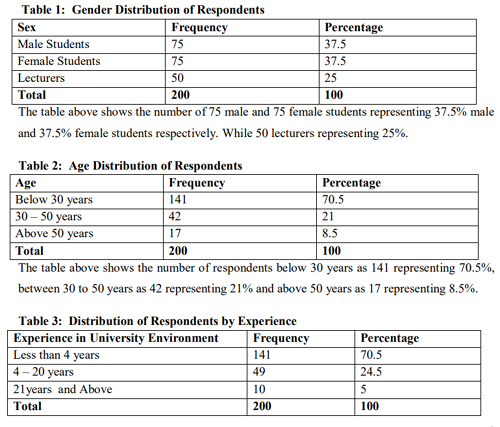
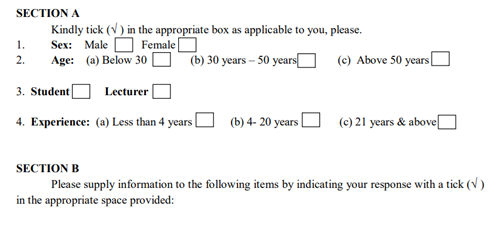
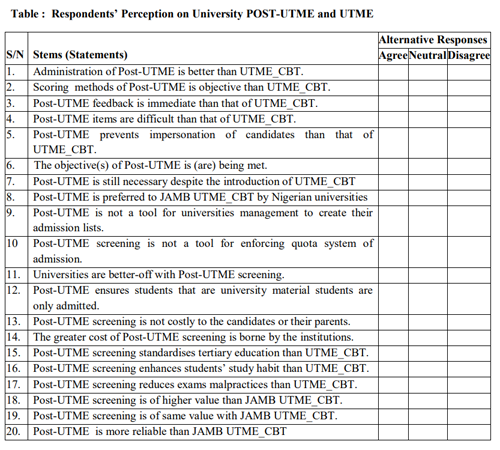
The question one may ask is that: Is Post-UTME still relevant as compare to UTME_CBT in terms of administration, scoring, feedback and standard in admitting students into Nigerian universities? Is Post-UTME still necessary with the introduction of UTME_CBT? Is (are) the objective(s) of Post-UTME being met? Is Post-UTME a tool for universities management to create their admission lists? Are universities more standard with Post-UTME screening? These and many more this study intend to ascertain. It is true that once admission is right, discipline, certification and products are likely to be right. From 1978 UME to 2012 UTME, JAMB examinations had always come in the Paper-andPencil Testing (PPT) format, but in 2013 and 2014 UTME, JAMB introduced Dual-Based Testing (DBT) i.e CBT alongside the usual PPT. In 2015, JAMB retained only the CBT mode which is an electronic form of UTME that adopts the use of computer to display and answer test items and give immediate results. On this therefore, JAMB is definitely taking a lead in the emergence of CBT as a popular mode of institutions examination in Nigeria. Since JAMB CBT employs finger print detective device in registering and screening candidate before the UTME, checking and scanning photographs of candidates, providing normal mathematical sets and calculator for the candidates, etc, it could be said that JAMB adopted these strategies to ensure credibility in its examination. With these measures therefore, it is clear that the issue of impersonation is now a thing of the past with JAMB. Also, the standard will be ensured. Now that JAMB has fully gone 100% e-testing in form of CBT to strengthen its UTME, do Nigerian universities still need to carryout Post-UTME? Statement of the Problem The existence of Post-UTME screening since 2005 alongside with UTME in admitting students into Nigerian universities is still contentious till date. Whether or not it should stay is still an unabated debate to many persons/institutions. Some publics like the parents, students, institutions, researchers, etc, are hitherto on the view that Post-UTME is unnecessary due to their tenets that it is a strategy adopted by the universities' authorities to extort students and create special admission lists like the VC list, Registrar list, etc. These antagonists of Post-UTME believed that as long as there is a fee for the collection of its form and that the exercise is being conducted by the institutions, its credibility will remain questionable. They equally believed that Post-UTME is a money-spinning venture for those institutions that are clamouring for it and that the examination had become ‘a cash-and-carry exercise’ for the highest bidders due to scarcity of admission spaces and placements in the universities. On the other hand, the proponents of Post-UTME uphold that the examination would help to ensure the best candidates are selected for admission; fish out those students who are not university materials and who cannot cope with university education, eliminate impersonation believed to have creep into JAMB UTME, amongst others. Since JAMB has unified and strengthened her examination with the introduction of UTME_CBT in 2015, is Post-UTME by Nigerian universities still relevant? Is there any basis for its existence alongside the UTME_CBT? This and many more are the brain behind this study. Thus, the study is therefore set to ascertain the relevance of Post-UTME in Nigerian universities. Purpose of the Study The major concern of this study was to ascertain the relevance or otherwise of Post-UTME in admitting students into Nigerian Universities alongside UTME_CBT by JAMB. Research Questions In a bid to guide and achieve the purpose of the study, the following questions were raised: 1. Is Post-UTME still relevant as compare to UTME_CBT in terms of administration, scoring, feedback and standard in admitting students into Nigerian universities? 2. Is Post-UTME still necessary with the introduction of UTME_CBT? 3. Is (are) the objective(s) of Post-UTME being met? 4. Is Post-UTME a tool for universities management to create their admission lists? 5. Are universities better-off with Post-UTME screening of students for admission? Hypothesis The Null hypothesis (Ho) that was formulated from the research questions and tested at .05 level of significant is: ‘there is no significant difference between Post-UTME and UTME_CBT screening of admitting students into Nigerian universities’. Research Design An exploratory survey research design was adopted for this study. This design was deemed appropriate due to its quantitative data collection approach and first-hand information collection. Population All the students and lecturers in the University of Benin, Benin City Edo State, Nigeria constituted the target population for the study. Sample and Sampling Techniques A sample of 200 respondents comprising 150 students and 50 lecturers was drawn from two faculties of the institution using simple random sampling technique. The sampling was done by placing pieces of papers of ‘Yes’ and ‘No’ labels in a school bag, the respondents that picked Yes were given the instrument to respond to. Instrument A self-constructed instrument tagged, ‘Questionnaire on Post-UTME Screening in Nigerian Universities (QPSNU)’ was used to collect data for the study. The instrument had two sections. Section A was on biological data of the respondents while section B contains 20 items on various variables that could help to ascertain the relevance or otherwise of Post-UTME in Nigerian universities. The instrument was validated by measurement experts and its reliability was established using split-half method of internal consistence reliability and it yielded a reliability coefficient of .86. Method of Data Collection Direst administration of the instrument on the respondents and immediate retrieval of same was done by the researcher. Method of Data Analysis The data obtained from the respondents’ responses were analysed with a statistical tool, chisquare [X2 ] to test the hypothesis at .05 level of significant (i.e 5% significance level). This statistical test was employed to determine the significant difference between Post-UTME and UTME_CBT. Chi-square [X2 ] is defined as: X2 = ∑ (O-E)2 E Where X2 = Statistical technique O = Observed frequencies E = Expected frequencies Data Analysis and Interpretation of Results The scores were analysed and interpreted to confirm or refute the stated hypothesis of the study. A total of two hundred respondents (i.e 150 students and 50 lecturers) were used for the study Below are tables showing the distribution pattern of the respondents.
The above table shows the number of respondents who have experience less than 4 years as 141 representing 70.5%, 4 to 20 years as 49 representing 24.5% and 21 years and above as 10 representing 5% TESTING THE HYPOTHESIS HO: There is no significant difference between Post-UTME and UTME_CBT screening in Nigerian universities.
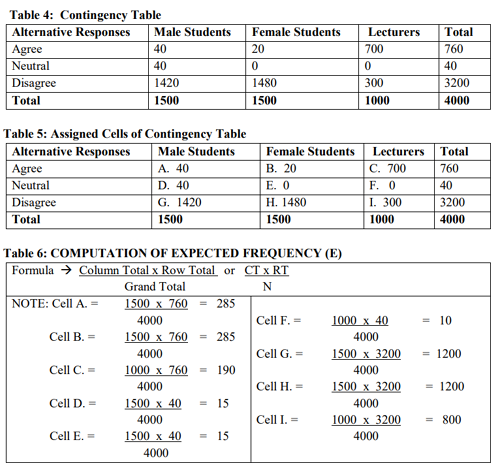
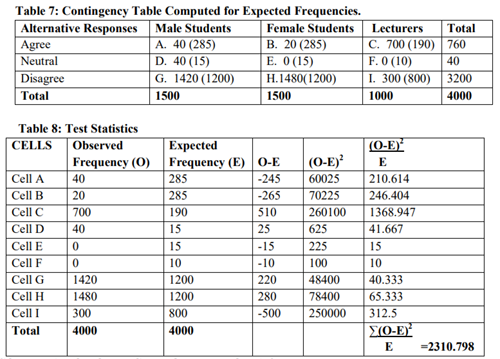
COMPUTATION OF DEGREE OF FREEDOM (df) Formula -> df = (c – 1) (r – 1) Where c = number of column r = number of row df = (3 – 1) (3 – 1) [since 3 rows and 3 columns in the contingency table]. df = 2 x 2 = 4 Significance level is .05 Calculated X2 value = 2310.798 Tabled critical X2 value = 9.49 Summary of findings The study was to ascertain the relevance or otherwise of Post-UTME screening in admitting students into Nigerian universities. Five research questions were raised and a hypothesis was formulated to guide the study. A self constructed instrument was validated and administered on the selected sample for the study. The data obtained were analysed with a statistical tool, chi-square [X2 ] to assess significant differences of the variables of the study. Based on the analysed data, the result revealed that the calculated X2 value of 2310.798 is greater than the tabled critical X2 value of 9.49, (i.e X2 Calculated > X2 tabulated) at 5% level of significance. Thus, the formulated null hypothesis (Ho) is rejected, as such, the alternative (H1) is accepted. That is, the Ho that says: ‘there is no significant difference between Post-UTME and UTME_CBT screening of admitting students into Nigerian universities’ is rejected. It therefore connotes that there is a difference between Post-UTME and UTME_CBT screening in Nigerian universities. It further means that Post-UTME screening as being conducted by Nigerian universities is different from JAMB UTME_CBT. Consequently, Post-UTME is unnecessary and unfair as it is not of same standard with UTME_CBT. Conclusion From the findings, it could be concluded that: Post-UTME screening by Nigerian universities is significantly different and substandard to UTME_CBT. Post-UTME is unnecessary and unfair since not of same standard with UTME_CBT. Post-UTME is a tool for universities management to create their admission lists and undermining the merit list of JAMB UTME_CBT. Nigerian universities are not better-off with Post-UTME screening in admitting students. Post-UTME is not relevant. Recommendations Based on the findings, it was recommended that: since JAMB has introduced UTME_CBT to eliminate sharp practices like cheating and impersonation by candidate, Post-UTME is no longer relevant. if Nigerian universities must insist on Post-UTME then its items must be of same standard with UTME_CBT if Post-UTME must exist it should not be a money-making venture for universities. That is, it should be administered with no cost, meaning its application form should be free to avoid posing additional financial burden on the students or their parents. if Post-UTME screening must remain, it should be transparently conducted and objectively scored like UTME_CBT. Special or administrators’ admission lists should not be allowed to supersede the merit admission lists. That is, merit should be the sole criterion for university admission in Nigeria over the influence of parents or guardians. This would motivate young persons seeking university admission to be studious. Similarly, the law governing examination malpractice should be enforced and culprits sanctioned to serve as a deterrent to others. These measures would make the university admission system trustworthy and strengthen the credibility of higher education in Nigeria. REFERENCES Amatareotubo, M. (2006). Post-UME screening: Matters arising. Posted to the Web: 8/30/2006 5:49:17pm: amasmozimo@yahoo.co.uk. Retrieved July 20, 2015 from website: http://www.onlinenigeria.com/articles/ Edukugho, E. (2012). JAMB, Post-UTME in battle of relevance. Retrieved July 18, 2015 from vanguard newspaper website: http://www.vanguardngr.com via www.google.com Exametry (2013). The Role of JAMB in the Nigerian Education System. Retrieved July 18, 2015 from exametry website: https://www.exametry.com/articles/ Isaac, O. B.(2010). Post-UME Screening Examination in Nigerian Universities: The University of Education, Ikere-Ekiti (Tunedik) Experience. Nimbe Adedipe Library. University of Agriculture, Abeokuta Ogun State, Nigeria. Retrieved July 20, 2015 from website: http://www.webpages.uidaho.edu/~mbolin/busayo.htm JAMB website: www.jamb.gov.ng Olayemi, I. K. & Oyelekan, O. S. (2009). Analysis Of Matriculation And Post-Matriculation Examination Scores Of Biological Science Students Of Federal University Of Technology, Minna Nigeria. Ilorin Journal of Education, 28, 11-18. Retrieved July 20, 2015 from website: https://www.unilorin.edu.ng/publications/oyelekanos/ PROFESSOR Samuel Ogheneovo Asagba: Post-UME Remains the Best Option for Admission. Retrieved July 18, 2015 from pointernews website: www.thepointernewsonline.com via www.google.com APPENDIX QUESTIONNAIRE ON POST-UTME SCREENING IN NIGERIAN UNIVERSITIES (QPSNU): STUDENTS AND LECTURERS’ PERSPECTIVE. Dear Respondent, This questionnaire is solely for research purpose. All information will be treated as such. People differ in their opinions about what is right and wrong on issues. This questionnaire is on whether Post Unified Tertiary Matriculation Examination (Post-UTME) Screening in Nigerian Universities should remain or not.
|
ISSN: 2411-5681 Online & Print Journal Information
Frequency: Monthly
News Attention to Authors The latest issue |
|
Copyright © 2013-2026 IJER - International Journal of Education and Research. All Rights Reserved • Privacy Policy |